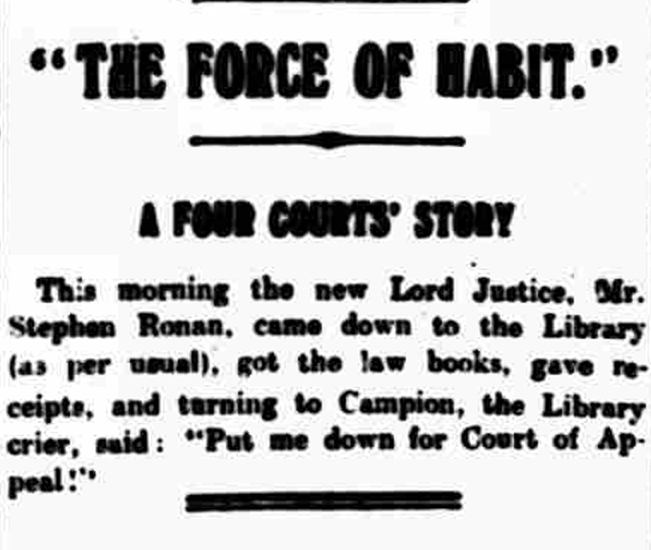
To understand the significance of the above piece from the Dublin Evening Telegraph of 9 February 1915 , you would need to know that the Law Library of the time had a notice board on which the whereabouts of each barrister in the Four Courts that day was written down. It had been introduced following complaints by solicitors that they could never find the barrister they were looking for, and continued to subsist until relatively recently.
The hardworking and intellectually brilliant Stephen Ronan, newly appointed Lord Justice of Appeal, was, with the above remark, bidding his final farewell to the Law Library as he moved west across the Four Courts yard to the elevated precincts of the Court of Appeal in Ireland.
Ronan, a keen walker, was renowned for his unusual working habits. Of delicate health, the first thing he did every day when he returned from court to his house at 45 Fitzwilliam Square was to have a nap. He rose again at 8 p.m. for dinner, client consultations, a nocturnal walk and some paperwork before going back to bed in the early hours for a further few hours’ sleep.
Also referenced in the above story is John Campion, Law Library Crier for 57 years, and just as important a figure in the Four Courts, if not more so, than any Lord Justice of Appeal.
Readers of these posts may already be familiar with former soldier William Bramley of the stentorian voice who held the position of crier of the Law Library, Four Courts, from 1869-1904 – a position which required its holder, in a pre-intercom age, to physically call out the name of any barrister being sought for therein (the notice board may have saved his vocal chords some work in this regard). John Campion was his successor.
Was Campion a relative of the gentle and beloved Serjeant William Campion QC, first Serjeant at Law, one of the most venerated members of the Bar of Ireland during his 67 years of practice? A brief obituary in the Irish Independent of 8 January 1949 tells us that he was from Dublin and began his career in the Four Courts as an attendant in its counsels’ dressing rooms, later being transferred to the new Law Library in the East Wing. In the course of his career, he saw his magnificent workplace occupied during the 1916 Rising and comprehensively destroyed in the Battle of the Four Courts of 1922.
When the Bar moved back to new premises the reconstructed Four Courts in 1931, Campion, still Law Library Crier, is reported as having taken charge of the packing. He died 18 years later at his son’s house in Lea Road, Sandymount. How much he was respected and beloved is evident from the below note in the Belfast-News-Letter of 4 January 1949:
“Members of the Northern Ireland Bar who are senior enough to have been ‘called’ in the days when there was only one Judiciary in Ireland will regret to learn of the death of John Campion, who was ‘crier’ at the Bar Library in the Four Courts, Dublin, for many years. Campion was a ‘character’ if ever there was one, and his treatment of all and sundry who came to his high desk in the Library to seek the whereabouts of the toilers therein was ever a source of information to the barristers. He had a very flexible voice, which could be raised sufficiently to make itself heard in what Campion always elegantly referred to as the ‘work room’ (really the smoke-room), a noisy place where everybody talked, or it could be dropped to a polite and insinuating whisper when it was intended to inform Mr TM Healy, KC, whose seat was only a few feet away from the desk, that someone had had the temerity to interrupt the great man’s labours. Campion was a mine of information about everything and everybody connected with the Four Courts, and with the aid of his chart, showing what Courts were sitting, and who was attending them, or his special knowledge of the habits of the barristers, he very seldom failed to ‘get his man’. And woe betide anyone, not a member of the Bar, who passed Campion’s desk to the floor of the Library, even if only by a yard! To Campion, that invisible line was sacrosanct. May he rest in peace.”
The above was signed ‘the Roamer’, its author presumably one of that substantial contingent of Irish barristers who opted for Belfast over Dublin after partition in 1921. No matter how far they roamed, the nostalgic tone of the above reminiscence suggests that at least one of the departed felt, like Lord Justice Ronan, that there was, for him, no place like his original Law Library home…


Leave a Reply