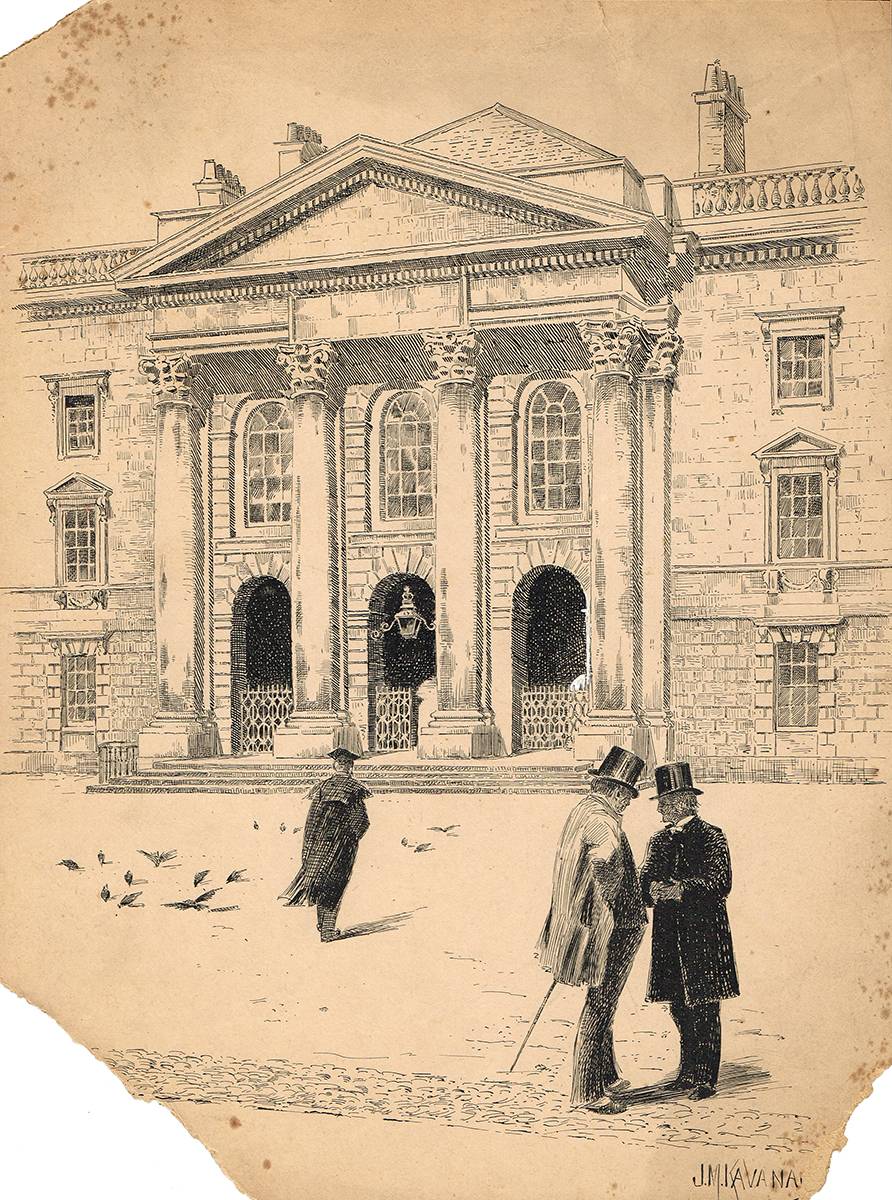
From the Cork Constitution, 7 August 1856:
“THE TRINITY COLLEGE ITALIAN PROFESSOR
(From the Daily News)
A singular case, not unlikely to be numbered among the cause célèbres, has just been tried at the summer assizes in the County of Kildare. We believe a few particulars may not be found uninteresting and may prove somewhat profitable to the generality of our English readers. The trial lasted five days, and on the evening of the last day – Wednesday July 30 – the jury were discharged without being able to agree upon a verdict.
The main facts are simply these: – Basilio Angeli, a native of Pieve di Monte, a village between the town and the baths of Lucca, left Italy in 1833, in the capacity of a workman to a plaster-cast manufacturer, by name Ippolito Lucchesi. He had, only a few days before his departure from Italy, married a peasant girl of the same village; but had quitted her, with her consent it appears, and the wife is at this present moment living as a domestic servant at Leghorn. Basilio Angeli travelled from Lucca to Paris, London, and Dublin, working as a plaster-cast manufacturer, or figurista, up to the year 1834, when he cut the workshop and set up as a Professor of the Italian Language and Literature in Dublin.
In the year 1849 the Italian and Spanish Professorship in Trinity College, Dublin, becoming vacant, Basilio Angeli applied for the situation and obtained it. The chair of Italian has a fixed salary of £150, beside rooms in college, a seat at the commons’ board & c. The professor is appointed by government, but only on the proposition and recommendation of the Board of Senior Fellows governing the institution.
No long time elapsed ere some of the students and Junior Fellows became aware of the utter unfitness of the new Professor for his place. It happened in the same year, 1849, that Sir Robert Kane wished to have an Italian translation of an inaugural speech delivered by him on the opening of the Queen’s College in Cork, and commissioned Angeli to execute the translation. The translation was so full of gross errors that some of the Junior Fellows, more especially Messrs. Galbraith, Haughton, and Ingram, felt bound to lay that translation before the governing Board, pointing out some of those errors which, in their judgment left no room for doubt as to the Professor’s incompetency to be a teacher of his own or of any other language. They went further – they proved that Angeli’s application for the Professorship was full of deliberate misstatements, and that he had obtained his appointment by imposing upon the Board.
The Professor was summoned before the Board and confronted with his accusers. He defended himself to the best of his abilities, and, as he had powerful friends among the Senior Fellows, the matter was hushed up. Subsequently the Provost of the College and some of the Senior Fellows went so far in their partiality to the Italian Professor as to propose to confer upon him the honorary degree of LLD, whereupon the same Junior Fellows returned to the charge, added fresh proofs of the correctness of their former assertions, and being supported by the authority of Dr Todd, a Senior Fellow and Librarian of the College, they succeeded in postponing the conferring of the intended honour. Dr Todd at the same time, to set the matter at rest, sent Basilio Angeli’s translation of Sir R. Kane’s address to Mr Panizzi, in London, asking his opinion as to the literary merits of that performance.
Mr Panizzi’s answer was of so pointed and decisive a nature that the Board, upon a perusal of it, unanimously agreed upon the immediate dismissal of the Professor, so far as in them lay, on the ground of utter incompetency. Angeli, ill-pleased with the decree of the Board, turned against his accusers, and brought an action for libel, defamation, and slander against Messrs. Galbraith, Haughton, and Ingram, claiming damages to the amount of £3,000. The trial was conducted by the Chief Justice, and some of the most eminent barristers appeared on either side. It had on the whole rather the air of a philological disquisition than of an ordinary lawsuit; but the question as to the competency of the Professor to teach his own language was settled to the satisfaction of the most illiterate juryman.
The plaintiff allowed himself to be involved in the most palpably absurd and contradictory assertions. Nor did the Italian witnesses brought forward in his behalf – Signor’s Ferretti, De Asarta and Feronia – show sufficient capacity to make the best of a bad case. The two latter-named were obscure persons; but Signor Ferretti is a teacher of Italian, as well as a minister of a ‘Free Italian Church’ in London, the editor of the Eco di Savonarola, a Protestant Italian polemic journal published in London, and has given lessons in the family of Lord Clarendon and other families of the highest distinction. How then could he state that la gran sala ere piena di signori d’ambo I sessi – literally ‘the great hall was full of gentlemen of both sexes’ may be considered only as ‘a vicious pleonasm;’ and that ‘there is no fault in that expression;’ that to spell cheffare instead of che fare is ‘only attributable to a too rigorous obedience to the pronunciation of Tuscany, which is considered to be the best pronunciation?’
On the other hand, the defendants produced the testimony of Mr Panizzi, the librarian of the British Museum, and of Professor Galanga, of London University College. The former not only repeated and substantiated the opinion by him expressed as to the merits of Angeli’s translation, in the letter to Dr Todd which led to the Professor’s dismissal, but quoted numerous other instances in which the translator had proved himself equally ignorant of the English and of the Italian languages, in which he had utterly misunderstood or misinterpreted the meaning of the original, in which he had been guilty of the most fearful outrages against all the rules of grammar, spelling, syntax & c of the language he professed to speak…
An appeal was made to the feelings of the jury by attempting to persuade them that Angeli was persecuted because he had raised himself from obscurity; but the truth is, that his personal history was only alluded to in order to prove the incorrectness of the account he had given of himself…
A… great… point in favour of candidates for appointment as public or private teacher is their conversion to Protestantism… Perhaps if candidates for foreign professorships had always been obliged to undergo a proper examination before competent judges – if it had been well understood that they were wanted to teach languages and not divinity or politics – and that, consequently, their religious persuasion or political conviction could have no weight on the resolution of the examiners, it is possible that… Trinity College might never have been exposed to the laughable revelations of the Court of Assize at Athy.”
You can read a full report of this amazing trial here.


Leave a Reply