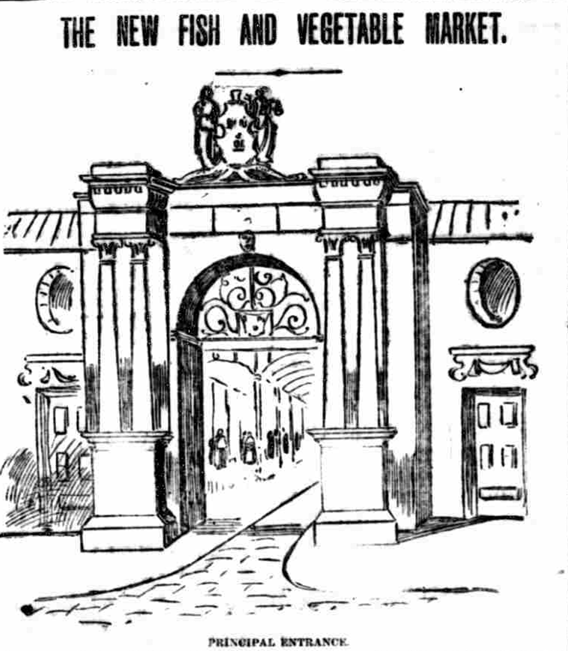
The Dublin Evening Telegraph of 5th September 1892 carried an account of the new Fish and Vegetable Market close to the Four Courts in Halston Street, due to be formally opened the following day, accompanied by beautiful illustrations including the one above:
“The new Fish and Vegetable Market, which has been long in the course of construction, may fairly be said to be finished at last. Tomorrow it will be formally opened by the Lord Mayor. In 1886 Dublin was in a bad way enough for a wholesale market and there was a great deal of agitation with the view of having this ‘long-felt want’ supplied. Resolution after resolution, and deputation after deputation, passed between the Municipal Council and the Markets Committee.
Indeed, the matter was before the Municipal Council for over 30 years. In 1858 a Royal Commission was appointed to enquire into the affairs of the markets of Ireland, and in November of the year referred to the Commission sat in Halston Street to inquire into the markets in Dublin. In their report, they stated that the Dublin Improvement Act empowered the Lord Mayor and Corporation to establish new markets and compensate existing interests, and that ‘no measures had been adopted to accomplish this desirable object, and the markets remained in the same unsatisfactory state as before the passing of the Act’…
For years, the different markets were held in the surrounding streets – butter, eggs, fowl and fruit were sold in Green Street, vegetables in May Lane and in Mary’s Lane, while Bonham street, Francis street, Thomas street and Booth Lane were also utilised. A private market was held in Kevin street and the potato market was very small and altogether inadequate, so that there was no wholesale market in Dublin under municipal control for the sale of provisions, fish, eggs, butter, fowl, vegetables, potatoes, fruit, or flowers.
In 1878-79 the Markets Committee had under consideration the providing of a suitable space for the use of retail dealers in fish standing in Pill Lane, in consequence of the refusal of the Police Magistrate to inflict fines on the dealers for standing there, but the matter having been fully reported to the Council, no further steps were taken. In 1883, a person who owned some land in the neighbourhood of Smithfield wrote to the committee, offering a site for wholesale markets, but the offer was declined with thanks.
A resolution was therefore adopted ordering the Engineer to report on convenient and suitable sites He advised that, on which the new market stands, and although his suggestion was at once adopted, many months were allowed to roll by before it was put into effect. In his report, the Engineer stated that the vegetable markets were a disgrace to the city, and should be got rid of. When the sub-committee visited the fruit and vegetable markets in 1884 they found everything in such a wretched condition that in their report they said ‘that in no city in Europe or America would such a state of things be allowed to exist for one moment longer than the exigencies of the case demanded. Everything in the markets seemed to be in confusion. Heaps of vegetables to be used afterwards for human food were lying together in ‘an accumulation of excrete;’ Fish and fruit were in the same plight.
The building of the new markets began about three years ago, and carried on with the utmost despatch. Mr. Connolly was the contractor for the stonework, Mr. Lysaght, of Huddersfield, for the ironwork; and Mr. Harty was the architect. The building as it stands today reflects very great credit on everybody who has been associated with it. The plan was conceived with the most judicious care, and the arrangement is first rate in every way.
Before anything could be done, the Corporation had to buy out the site of the old market and all the houses built on it, at a cost of nearly £60,000. All the houses facing the market in East Arran Street are the property of the Corporation and it is intended to make these a source of profit by renovating and letting them.
The market covers an area of 60,000 square feet and is one of the largest in the United Kingdom. It has no want of ‘exits and entrances,’ there being no fewer than four splendid gates leading into it from East Arran street, Halston street, St Mary’s Lane and Halston street. While the market was being constructed, the advice was sought as to the arrangement of spaces of many experienced persons whose knowledge qualified them to speak, so that there can be no want on this score. Besides, these spaces have been so arranged that there can be no friction among the various merchants who sell fish, fruit and vegetables.
The laying out of the streets was also done in consultation with the different tradesmen and with great advantage to the trade. Great care has been taken to have the markets properly ventilated and to secure an absence of that nasty smell which is in most cases inseparable from markets. The interior of the walls will be glazed for a height of about six feet from the bases, and there will be hydrants on every side ,so that the entire market may be washed in about half an hour. There are open grills in the arches along the walls and over the gates and doors, thus making way for the admission of fresh air. The sanitary arrangements are excellent.
An interesting feature of the new market will be a suite of comfortable and well-equipped refreshment rooms. There will be special rooms allotted to both sexes in which first-class lunches may be procured, but – Oh, the pity of it, no intoxicating drinks will be sold. So the proverbial fish woman who usually loves her ‘dhrop’ must find it outside the precincts of the market.
One of the best results that will follow from the establishment of the new market is that it will affect a centralization, so to say, of the various metiers, in other words a correlation of forces as your scientific scholar would put it. Instead of fish being sold in one street, vegetables in another and potatoes in a third, you will have them all sold for the future within the market.
Well no -not all. The fruit sellers elect to remain out. They prefer to pursue the even tenor of the way in the old market and they have adopted this course, though the Corporation have offered them very in tempting inducements to go in and join hands with the rest.
A day or two ago as the Telegraph Man was wandering in that odiferous locality around Pill Lane, he heard one who ought to know say there will be an excellent opening in the market for a fruit merchant, and to those will be an excellent opening in the market for a fruit merchant and to those of you who are in the fruit-selling line, I gladly give this valuable tip free, gratis and for nothing.”
Since the market subsequently became known as the Dublin Fruit and Vegetable Market, presumably the fruit-sellers ultimately decided to take up this offer!


Leave a Reply