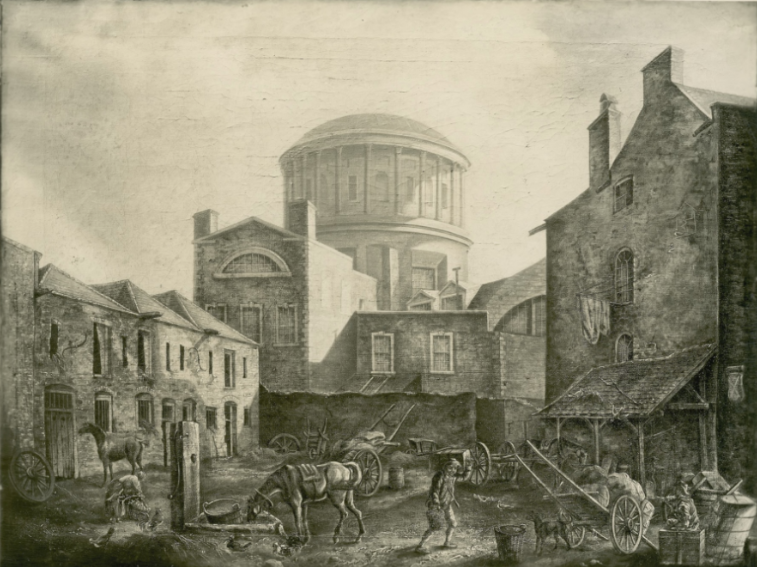

I had the privilege this week of taking a lovely group of visitors through the Four Courts. As there were no handouts, I said I would put the content of the tour up online, together with some illustrations, so here it is.
It was not possible to go through all parts of the building, but we did get to do the Round Hall, the area at the rear in front of the Supreme Court and the Square Hall in front of the Law Library.
The Round Hall
The current Four Courts building opened for business in the autumn of 1796. It had been designed by architect James Gandon, who adapted an earlier building by Thomas Cooley, which had originally been constructed for use as a public records office.
The building was called the Four Courts because at that time the superior courts system in Ireland consisted of four separate courts: King’s Bench; Common Pleas, Chancery and Exchequer. Then and now, those entering the Four Courts building from the river side pass through a portico into a beautiful circular hall with courtrooms off it for each of the four courts. This hall, known as the Round Hall, is topped with a double dome, In the past, this dome was a popular hangout for pigeons. When things became too busy up there, selected locals used to be allowed in with rifles to clear out its unfortunate inhabitants.
Not everyone was entirely happy with Gandon’s design. For instance, the original lowered floor of the Round Hall had to be raised following complaints that it made the Hall resemble a Roman bath. But, raised floor or not, the Round Hall in the first half of the 19th century did indeed become a sort of bath, with persons of every creed, profession and class, lawyer and non-lawyer alike, flowing in and out of it like water. Although the passing of the Act of Union in 1801 had removed Ireland’s Parliament, the country still retained its own separate court system, which during this period, was the only official symbol of Irishness remaining.
Perhaps this was one of the reasons why even those with no legal business in the Four Courts were drawn to it like a magnet. In an era of few newspapers and no internet, the Round Hall was the place Dubliners came to exchange news and gossip, sample the pastries and fruit sold from stalls within its precincts, and to avail of free entertainment – and, in winter, roaring fires – within its courtrooms.

Much of what was discussed in the Round Hall was political and indeed politics and the legal profession in Ireland have always been inextricably linked. Several barristers were executed for their part in the 1798 Rebellion, which occurred shortly after the opening of the Four Courts. The next rebellion of 1803, led by an Irish barrister, Robert Emmet, struck closer to home. A short distance away from the Four Courts, the then Lord Chief Justice of Ireland was dragged from his carriage by rebels and piked to death. In retaliation, some members of the Bar sought to flog captured rebels in the Round Hall. Cooler-headed colleagues restrained them on the basis that this would be a profanation of a house of justice.
That said, profanation of the Round Hall by violence was nothing new, with fistfights, horse-whippings and waving of detonating guns a not uncommon occurrence. Many were the challenges to duels laid down there, and most accepted – unless cooler-headed friends could negotiate a graceful exit for the protagonist. In the early 19th century, for a lawyer to kill someone in a duel was no impediment to their professional progress. The most famous such duel was between barrister and politician Daniel O’Connell and John d’Esterre in 1815, in which d’Esterre was killed, a tragedy which haunted O’Connell throughout his life.
O’Connell, one of the most renowned practitioners at the Irish Bar, was also a Catholic. For most of the 18th century, Irish Catholics were excluded from the legal profession. Even when this exclusion was removed, a ceiling was put on their professional progress; they could be solicitors and junior barristers but could not become Queen’s Counsel (senior barristers) or judges. For early 19th century Irish Catholics, Daniel O’Connell’s success was a symbol of their progress. After making his name at the bar, O’Connell went on to become even more famous as a politician – something which annoyed many in the establishment and led to his arrest and trial for conspiracy. He was convicted but subsequently released to great acclaim. However, his health had been fatally undermined by imprisonment, and he died some years later.

Only a few years after O’Connell’s trial came the Great Famine – and after that the Round Hall was never the same again. Early 19th century Ireland had seen a litigation boom as Catholics sought to participate in the legal system not only as lawyers but as litigants. After the Famine, there was little money for litigation, and the Round Hall emptied. Financial necessity led an increasing number of lawyers to opt to court the existing regime – which had many lucrative sinecures in its gift – rather than to challenge it.
Things changed again at the beginning of the 20th century when Ireland was shaken by another rebellion, yet again spearheaded by a barrister, albeit one without a practice. The barrister in question, Patrick Pearse, had appeared in only one notable case, in which he had unsuccessfully defended a client’s right to paint his name in Irish on a cart. Pearse subsequently forsook law for education, setting up St Enda’s school in Rathfarnham. In 1916, he was to turn Dublin upside down with his Easter Rising, in which the Four Courts, along with many other notable buildings, were occupied by his rebel troops.
Although the Bar was quick to dissociate itself from Pearse in the immediate aftermath of the Rising, there was respect for the rebels’ gentlemanly treatment of the Four Courts, The impressive drinks cabinet in the barristers’ tearoom remained untouched, and all that needed to be cleared up afterwards were some broken windows and a few unexploded bombs in the Law Library.
The decision of the British government to execute Pearse and other rebel leaders contributed to the Irish War of Independence which took place in the period 1919-21. Ongoing conflict culminated in another, more damaging, occupation of the Four Courts by rebels in the summer of 1922. By this time, the rebels and the men in charge were both Irish; a treaty had been signed with Britain providing for the establishment of an Irish Free State, albeit one which was still a dominion of the British Empire.

The Anti-Treatyites, as the rebels were called, wanted complete independence. In protest against the Treaty, they occupied the Four Courts for several months in the spring/summer of 1922 before being ousted by the Free State forces in what became known as the Battle of the Four Courts. The resulting destruction was comprehensive; the below photographs show the state of the Round Hall after the 1922 occupation. Most of the damage was due to the explosion of a munitions store in the basement of the rear extension of the building. This explosion also destroyed the Public Records Office situate within the Four Courts complex, resulting in the loss of many precious Irish historical records; the ramifications of this destruction are still being felt by historians and genealogists today.

It took several years to reconstruct the Four Courts, which did not reopen until 1931. The reconstructed Round Hall, while structurally similar to Gandon’s original, lacked many decorative features which had previously graced it and the statues which had stood in its arches were never replaced.
The Supreme Court
The reconstruction included the erection of a new Supreme Court in the space behind the Round Hall previously occupied by the original Law Library – a special place within the Four Courts sacrosanct to Irish barristers, who, unlike English barristers, do not work in chambers. No person who was not a barrister could enter this sanctum; guarding its entrance was a crier, who called out to its occupants the names of barristers being sought. The original law library had sanitary difficulties and was closed in 1895 and replaced by a sumptuous new law library in another part of the building. Sadly, this new, magnificent, structure perished in the destruction of 1922.
The courts system established by the Irish Free State not only provided for a successor of the original four courts in the form of the High Court, but also a Supreme Court, located where the original Law Library had once been. Although normally entered by side doors, there are two large double doors at the entrance to the Supreme Court, rarely seen open. Some say that they may perhaps be opened for the funeral of a particularly important Chief Justice.
Close to these double doors is a memorial to the 1798 Rebellion. Much vilified at the time, its instigators are now heroes. A commemoration of Patrick Pearse may be found close to the new Law Library. Many are the the changes in perception effected by time!
The Square Hall and Law Library
Behind the Supreme Court is a corridor leading to a rear extension erected c.1830. At the end of this corridor is a square hall leading to the third and current Law Library. Inside may be seen an ever-changing flow of Irish barristers, some in court dress, some in business suits. In the past, court dress for barristers meant a horsehair wig and a gown (made of stuff for junior barristers, silk for seniors), with a bib or tabs worn around the neck. Few barristers in civil practice today wear the now-optional wig, but the gown and tabs remain compulsory.
Although one might think from this retention of the traditional costume that the Irish Bar is an organisation in stasis, in fact it has changed greatly since the opening of the Four Courts. As mentioned, the 19th century was notable for its expansion to include Catholic barristers. The early 20th century, on the other hand, was a time of contraction for the bar. A significant number of its members died in the 1914-18 war. A beautiful exhibition commemorating those who died is on display near the Law Library; it can be viewed online here. Those who returned found Ireland much changed due to the activities of their little-known colleague Patrick Pearse. Many, dissatisfied with the new regime, chose to move to England. Moreover, the Irish Free State did not extend to the entire island of Ireland; barristers practicing in the northern counties of Ireland left to form the bar of Northern Ireland.
However, in the late 20th century, the Irish bar began to expand and diversify once more, due to the increase in women barristers. Although women were first admitted to the Irish bar in the 1920s, it was difficult for them to acquire or maintain a practice. Things began to change from the 1970s onwards, and now, in thee 21st century, there are a high proportion not only of women barristers (including numerous Senior Counsel), but also women judges. Today, the Irish Bar seeks to further expand the diversity of its composition.
If you found this account of the Four Courts interesting, there are some posts on this website which relate to the matters discussed above:
- During the heated conspiracy trial of Daniel O’Connell in 1844, Ireland’s attorney general, annoyed at another counsel, sends him a challenge to a duel in open court.
- An account of Patrick Pearse’s only reported case, defending a man’s right to put his name in Irish on his cart.
- An account of Ireland’s Chief Justices – and the mysterious double doors of the Supreme Court
- An investigation into bones found in the Square Hall traces their origin to the lunchbox of an impoverished barrister.
- The alcohol cabinet in the Four Courts tearoom remains untouched during the occupation of 1916
- A storm causes consternation in the first Law Library as barristers run for cover.
And also the following, just because they are intriguing!
- A 19th century comparison of the Irish and English Bar.
- A lawyer negotiates his own ransom during the Irish Civil War – and then sues for its recovery.
- In the early days of the Four Courts, three judges struggle to determine what to do with a baby found in one of its corridors.
- A case from the early 19th century Four Courts: young love turns to tears as an Irish woman sues in respect of her rape by a Dublin rake.
- The chequered career of the enigmatic Lord Justice Moriarty, schoolmate of Sir Arthur Conan Doyle and reputedly the model for the villainous Professor Moriarty of the Sherlock Holmes story.
- More Four Courts litigation in the form of the famous Cork Slander case of the same period, brought by a great-great uncle of Princess Diana


Leave a Reply