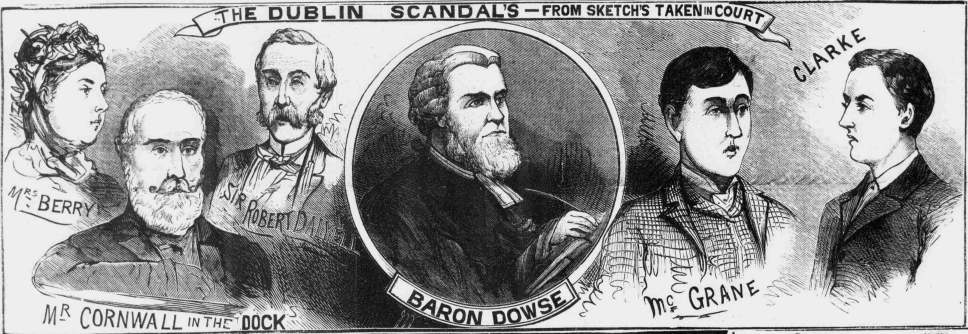
That phenomenon of litigation and prosecution which became known as ‘the Dublin Scandals’ commenced in 1883 with a series of articles published by William O’Brien M.P. in his journal ‘United Ireland’.
The articles were directed at James Ellis French, chief of the Detective Department of the Royal Irish Constabulary, whom it was suggested had been guilty of felony of ‘an unnatural kind’ – an expression generally understood as referring to the offence of buggery or sodomy.
French promptly brought a libel action against O’Brien, who retained a disgraced Scotland Yard detective, John Meiklejohn, to gather evidence justifying the assertion. French failed to progress his action and O’Brien succeeded in having it struck out for want of prosecution.
Witnesses obtained by Meiklejohn for the purpose of the now defunct French proceedings had also incriminated Gustavus Cornwall, the 62-year-old married head of the Irish Post Office. After French’s libel action had been struck out, United Ireland, on 10th May 1884, published an article about Cornwall suggesting that he had the same ‘tastes’ as French; O’Brien also made similar allegations in the House of Commons.

Cornwall sued O’Brien for libel. Litigation being speedier in those days, the case was set down for hearing in the Four Courts in early July 1884. Witnesses called by O’Brien included Alfred McKiernan, a 32-year-old clerk with the Munster Bank, who testified that he had met Cornwall at a dinner party in Raglan Road, Ballsbridge, on an autumn evening in 1876, and that night had become intimate with him. The intimacy, intense while it lasted, came to an end three months later, when another gentleman moved into Cornwall’s mansion at 17 Harcourt Street.

George Taylor, a 23-year-old clerk with the British and Irish Steam Packet Company, also gave evidence that he had been introduced to Cornwall in 1881 by a 37-year-old militia officer, Martin Oranmore Kirwan. Cornwall began to send Taylor free tickets to concerts and flower shows. In the summer of 1883, the men met once again at a dinner party in Lansdowne Road, Ballsbridge, and once again Cornwall did not return to Harcourt Street unaccompanied, Mrs. Cornwall being conveniently out of town on both occasions.

Robert Malcolm Johnston, aged 21, son of the late proprietor of Johnston’s Bakery, Ballsbridge (still operating today as Johnston Mooney and O’Brien) also gave evidence that he had been introduced to Cornwall by Kirwan. According to Johnston, Cornwall had placed his hand on Johnston’s knee and attempted to take improper liberties while travelling in a hansom cab between the Botanic and Zoological Gardens, Johnston, who did not find Cornwall attractive, rejected his advances.
The jury found that the United Ireland article was a libel, but that it was justified i.e., it was more likely than not, on the balance of probabilities, that Cornwall had engaged in at least one of the acts alleged.
Within a few days of the libel verdict, Cornwall was arrested in Scotland and charged with having committed sodomy with William Clarke, a 22-year-old Guinness cooper from Usher’s Quay, Dublin, and of having conspired with Kirwan to procure Johnston, Taylor and other young men and boys and incite them to sodomy, other carnal offences and lewd, filthy and indecent acts. Kirwan and French were likewise charged with procuring and inciting.
The following were also arrested and charged:
James Pillar, aged between 60 and 70, of 56 Rathmines Road and Palmerstown Park, a married wine and tea merchant with a large family, was charged with having sodomised Johnston, Taylor, McKiernan, Clarke and several soldiers.
Albert ‘Juan’ Fernandez, aged about 40, army surgeon, was charged with having sodomised Malcolm Johnston during a joint holiday in Killarney. Johnston, being wealthier than many of the other young men involved in the scandal, felt under no obligation to accept advances from those he found unappealing, and there appears to have been a genuine romantic connection between him and Fernandez – albeit one which Johnston’s evidence, presumably given to save himself from prosecution, must have inevitably severed for good.
Robert Fowler, a lodging keeper living in Golden Lane, Dublin, who provided Pillar with rooms for sexual encounters, and Daniel Considine, of Great Ship Street, a blind basket maker who had previously played women’s parts in theatrical performances at Dublin Castle, were charged with conspiring to procure and incite young men and boys and running a disorderly house.
Johnston Lyttle, aged 22, a clerk in Jameson’s Distillery, Bow Street, was also charged with sodomising his cousin Malcolm Johnston. Included in the prosecution brief against Lyttle is a touching letter from a schoolfriend ‘Ned,’ expressing love, affection and concern for his wellbeing following his arrest – a rare bright light in an almost overwhelming mass of bleakness.
With impressive speed inconceivable today, the first round of criminal trials commenced only a couple of weeks after the libel verdict.
French successfully claimed unfitness to plead. Pillar, against the advice of his lawyers, pleaded guilty and was sentenced to a life term of 20 years’ imprisonment. Considine and Fowler defended themselves, were found guilty and sentenced to 2 years’ imprisonment.
The charges against Lyttle and Fernandez were struck out since, at the time, it was not possible to convict for a sexual offence on the evidence of a participant in the absence of independent corroborating evidence, and no such evidence was present in their cases.
Yet again, one wonders why these charges were brought in the first place.

Cornwall was acquitted of sodomy, but a subsequent jury was unable to come to a verdict on the conspiracy charge against him and Kirwan. Their retrial on this charge took place in December 1884, with French’s trial also proceeding on the basis that he was now fit to plead. Cornwall and Kirwan were acquitted. French was convicted and sentenced to two years’ imprisonment.
Cornwall lived out the rest of his life quietly on his Scottish estates. Obituaries in the Scottish newspapers carefully omitted any reference to his time in Dublin. Pillar was released from prison in 1894, on grounds of ill-health, and died shortly afterwards. French disappeared into obscurity after his release from prison. Johnston Lyttle moved to South Africa and married. Fowler died in 1889 and Considine in 1898. Martin Oranmore Kirwan died in Galway in 1904. I have not been able to find anything more on Taylor, McKiernan, Clarke or Malcolm Johnston.
Other names which came up in the trial, apart from the above, were:
- Mr Gardiner, allegedly a Member of Parliament who had written to Kirwan about 14-year-old Malcolm Johnston after meeting him in Homburg, Germany. On Johnston’s return to Dublin, Kirwan invited him to dinner at the Kildare Street Club with a view to introducing him to the world of Dublin homosexuality. The host had experience in this field; George Taylor deposed to having been propositioned by him on the way home from the High School, Harcourt Street, as a teenager.
- St John Braddell, of Raglan and later Landsdowne Road, a married amateur musician and host of the musical parties at which Cornwall struck lucky with Taylor and McKiernan.
- Richard Boyle, a banker who fled Ireland for Spain (and later England) due to the scandals, for fear of being prosecuted. Rictor Norton, a descendant of Richard, writes on the Dublin Scandals here.
- Father Paul Keogh, a Catholic clergyman who attended a so-called ‘bitches’ ball’ for male prostitutes held by Malcolm Johnston in his family home in Clyde Road. He likewise fled the country. Oddly, St. John Braddell, who also attended the ball, remained in Dublin apparently untouched by any scandal.
- Thomas Hutchinson, a Protestant clergyman also present at the ball.
- Charles Fitzgerald, a young singer who rushed into court during the libel trial and asked to address the jury (his name had been mentioned in court the previous day). Perhaps out of kindness, lest he expose himself to prosecution, the judge had him removed from the courtroom.
- Lieutenant Villiers Sankey, responsible for introducing to James Pillar the young Malcolm Johnston and a multitude of soldiers, one of whom deposed that, during intimacy, Pillar informed him that he had ‘had five or six different men already that week,’ and that when he got to his age, he would understand that ‘a man could give you something that a woman cannot.’
Certainly, the young men whom Pillar mentored were easy prey in terms of manipulation. Sharp-minded Baron Dowse, presiding over the trials, remarked that there was one thing that all the disparate witnesses in each of the cases had in common – they knew (often in the biblical sense) this elderly homosexual lothario. A letter by Pillar to an unidentified person, included in the book of depositions, and certain remarks deposed to as having been made by him during intimacy, suggest that, whether those who encountered him knew it or not, he may have been testing them for prospective clients.

The most likeable characters in the whole sorry saga are Guinness employee Willliam Clarke and his theatrical friend Michael McGrane, occasional star performer of ‘ladies’ parts’ at the local Temperance Hall. Quick-witted and funny, the depositions of these part-time male prostitutes give us a unique insight into the hidden history of 19th century Dublin.
As Clarke & McGrane describe their meanderings around Grafton Street, Trinity College, Brunswick Street, the Liberties and the Quays, the sometimes magical, sometimes nightmarish, secret city of which they were a part briefly opens its doors to let us in. One can only hope that life did not let that pair down.
All images from the Police News, via British Newspaper Archive.


Leave a Reply