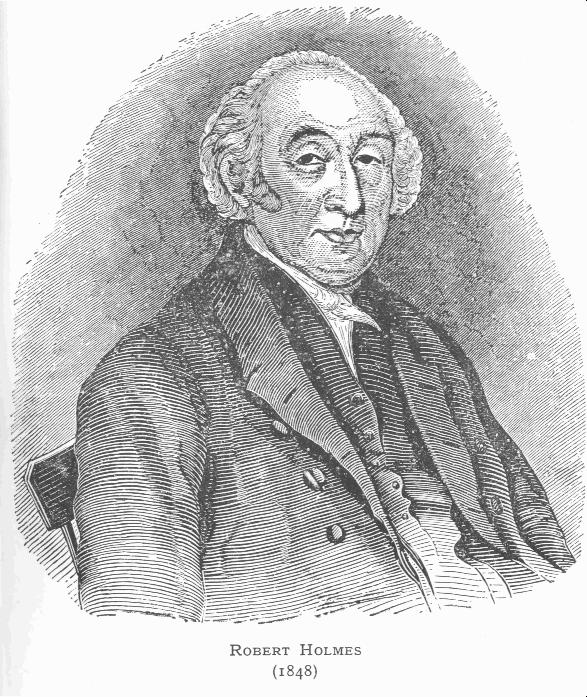

From the Freeman’s Journal, 11 June 1857, this premature obituary of Robert Holmes, who was not in fact dead at the date it was published, and did not pass away until two years later:
“Robert Holmes
With great regret we heard of the death of this great lawyer in London, where he had for some years resided with his only daughter. Since his retirement from the Irish Bar, he never revisited the scene of his former triumphs, although he felt a deep interest in all that concerned it, and he made particular inquiries about his old associates, of whom few now survive. They are passing rapidly away. The links that connect the present with the past are yielding to the crumbling tooth of time and in a few years none will remain to remind us of the days when intellectual giants contended for the mastery in the arena of professional and public life…
We always thought, and the bar of which he was the most distinguished ornament was of the same opinion, that Robert Holmes in the structure of his mind, in the successes that he achieved, in the various character qualities he displayed as a lawyer and advocate, reached his highest standard of professional distinction. In close and compact reasoning he could not compare with Plunkett, in popular eloquence with O’Connell, in profound knowledge of law with Burton or Joy, but he was nonetheless furnished with all the qualities which constitute greatness in the true sense of the word and he may well take rank with that remarkable race of lawyers and advocates whom we shall now know only by tradition. We do not intend to write a biography of Robert Holmes, the task is beyond our power and our province, but we may record a few facts and illustrate them with a few observations as the last tribute to the memory of an illustrious Irishman.
There is a difference of opinion about his birthplace. Dublin and Belfast lay claim to the honour. He was born, we believe, in the neighbourhood of Belfast about 1762, so that he had reached the very advanced age of 95 years. He entered college in the memorable year of free Parliament, free trade, and from the recollections of 1782 he derived much of that enduring and inflexible patriotism which marked his whole life. His class fellow and competitor was the late Chief Justice Bushe, whose polished genius delighted and exalted in classical literature, while the severer pursuit of mathematical science attached to the more solid faculties of Holmes. He was called to the Bar in 1795 when he had reached the mature age of 32. Previously, he had turned his attention to physic.
The adverse circumstances which beset his early career at the bar, it is unnecessary to recall. He had to struggle against difficulties which none living in these more fortunate times can adequately comprehend. His only inheritance were the gifts of nature, a strong intelligence and manly love of labour. He trained himself by careful study and imbibed that clear and precise knowledge of principles which he had always displayed with consummate effect and disciplined ease. With these elements of success he combined a pure sober judgment and unrivalled common sense. With such preparation he was content to abide his time, for it surely was to come.
There were then a vigorous and promising race of aspirants for a name at the Irish Bar, the two Pennefathers, Bushe, Burton, Goold, O’Connell, Wallace, Holmes and several others. The old nobles of the robe were dropping off—Ball, Burston, O’Neill, Ponsonby and Curran. A few were still in the prime of years and intellect—Plunkett, Saurin, Joy, O’Grady, Burrowes. Such were the conspicuous names at the Irish Bar when Mr. Holmes appeared, and perhaps none ever presented such a constellation of genius. The Union had precipitated on the Bar the splendid aggregate of which the Parliament had absorbed a large portion, and hence the difficulty of obtaining distinction where the competition was so great and the excellence so unexampled. Some took a rapid lead, partly from their influence and partly from their talents, while others such as O’Connell, Wallace and Holmes were forced into the rear waiting for the order of time to move up the reserve.
Gradually, Mr. Holmes moved to the front. His learning, his judgment, his minute preparation, his convincing argument and impressive eloquence at length firmly entrenched him in public approbation and for 30 years placed him at the head of the Common Law Bar of Ireland. His connection with the Emmet family is well known and need not be repeated. To that connection may be attributed the suspicion as well as persecution to which he was exposed in the early part of his career.
We shall reproduce one or two circumstances which are said to have moulded his character and inclined it to republicanism. He was a member of the Lawyers’ Corps commanded by Mr. Saurin. A general order was read and prayed that the Corps must submit to the code military and be divested of its civic character. Holmes, who had witnessed a flogging scene in the public streets, fearing the Corps would be called on to witness similar acts of brutality, threw down his arms and stepped out of the ranks. This revolt against authority roused the indignation of the late Chief Baron Joy, who had a resolution passed in the North-East Bar that any person not enrolled in the Corps was unworthy of being considered a member of the Bar. Holmes attended the next Bar dinner where the resolution was read, Mr. Joy adding that, if any person present held the resolution applied to him, he ought to leave the room.
Holmes accepted the application and protested against the jurisdiction of the Bar to take cognizance of political offences. He then left the room and sent a message to Mr. Joy. The interval of a day was requested to enable Mr. Joy to consult with his friends and, on its expiration, while Mr. Holmes was entertaining some friends at dinner, he was arrested and compelled to give bail. A criminal information was next applied for. Cause was shown by Curran and Plunkett, rule absolute, but to save trouble Holmes pleaded guilty and Lord Kilwarden sentenced him to six months imprisonment. Half the sentence was remitted, but Mr. Holmes read law for three months in a Kilmainham dungeon.
Another circumstance has coloured the early life of Mr. Holmes. He had returned from Dublin from London the very morning of the Emmet outbreak. He was wholly ignorant of that foolish insurrection, but his house was forced open, his papers seized, and he himself committed to prison on suspicion. Other dreadful consequences followed which never passed from the mind of Mr. Holmes and which there is no necessity to reopen now.
It is no exaggeration to say that a more able and virtuous man than Robert Holmes never adorned the profession of the law in this country. With a mind for which philosophy and literature had many attractions and gifted with a fine imagination which he knew how to subjugate, the control of the reasoning faculty, he acquired by persevering labour rather a comprehensive than profound knowledge of the most intricate of all sciences.
His great success may in a great measure be ascribed to a singularly correct judgment, his plain downright common sense, and the practical soundness rather than the learning and ingenuity of his arguments. There never was an advocate who relied less on the conceits of the profession. Strong in manly reasoning, he rarely had recourse to his counterpart’s smartness and subtlety. What Swift was in literature, he was in law. He had a mastery facility of exposition which renders his articles perfect models. Everything was so chaste, so embarrassed and free from pretension, the parts fitted so closely, the parts so luminously arranged, and the law so compact, well digested and closely applied that you were at once satisfied of his surpassing skill and superiority.
Though not a case lawyer or running too closely on the bold headlines of authority, there were few who could pursue the law through the winding stream of cases with greater sagacity and success. He generally contented himself with a few picked authorities without weighing differences and resemblances too nicely or tracing analogies and consequences beyond the summit level of common sense. At Nisi Prius Mr. Holmes preserved much of the eloquent heat and brilliancy of the old bar without its irregular and useless blaze.
In his 80th year he was still the most eloquent man in the profession. On great occasions his address to juries combined the very highest qualities of oratory. His defence of the Nation and his Case of Ireland, a written speech rather than a studied essay, and some passages in his masterly argument in the case of Watson v. Dill, illustrate his peculiar style of eloquence. The first has been considered its masterpiece. It had at least a wider influence and rendered his name more popular than all his other speeches.
He had no action. The only effort he used in this Department of Art was an unsuccessful application of the left hand when he wished to be particularly impressive.
In the defence of The Nation his mind was never more vigorous, or his imagination more brilliant, but time told on the delivery. Opinion differed as to its merits. Some considered it a poor defence, while others saw its complete triumph in the disagreement of the jury. Certainly, few speeches ever spoken were better calculated to draw the good men from the real issue. To bewilder the jury with an essay on the evils of misgovernment seemed to many an abandonment of his client but he knew the materials on which he had to operate, and the result at least justified his selection of topics.
Eminent as he was for his various endowments, and worthy as they were of ranking him among the men whose genius shed a redeeming luster on our country, it is moral worth which constitutes his chief claim in our admiration, and of all who can honor consistency pursued through more than half a century without a tarnish on its luster. Undeviating integrity was the foundation of that character which invested him with the name of the Irish Aristides. He refused a crown prosecutorship for Mr. Saurin in the beginning of his career when government sought to gain him over and 20 years later the Marquis of Anglesey pressed on him a silk gown with the distinct intonation that the solicitor-generalship would follow. But he resolved to take no honour or office from any government, and… he preferred the stuffed gown of the Junior Bar to all the silk in Macclesfield. It was singular to hear him address the court from the outer bar, the conventional junior of men who were at school when he was contending with a bygone generation of eminent lawyers.
Many ascribed his refusal of office to a saturnine impracticable temper. Perhaps so, but to our minds the cause was omitted which satisfied the whole inquiry. If he was ambitious, it was of his independence. With the plain and simple sobriety of a smartened citizen, with habits almost frugal, with few wants and those easily satisfied, with no male offspring to perpetuate his name, with none of those spurs to ambition which act on other minds, and with that well-balanced understanding which estimates at their true value those accidents of fortune for which the generality of mankind are ever on the watch, we can discover in in those circumstances, the true motives which determined his conduct. He loved money and amassed it fast. It is said that he realized altogether at the bar the large sum of a hundred thousand pounds, the largest we believe ever acquired by a stuff gown, except Lord Clare’s father who left him four thousand pounds a year and landed property, besides a very considerable sum of money.
Of fear in any of its shapes Mr. Holmes knew nothing. In old times when leaders were bullies, when the man with one degree of courage tyrannized over him who had none at all, and the former in his turn succumbed to another whose courage rose a little higher in the scale of resolution, Mr. Holmes neither inspired nor entertained fear. He intimidated none and suffered none to intimidation. When Wallace facetiously said to a distinguished lawyer who had the temerity to set him right in a matter of fact, ‘Sit down sir, you know the consequence,’ Mr. Holmes would have sat down but the consequence would have periled the safety of the challenger. Wallace knew well the manner of man he bullied. That man was not Robert Holmes.
In person Mr. Holmes was eminently handsome. In his youth he was said to be one of the handsomest men in Ireland, and to the last, he retained the traces of his former beauty. A few summers ago, we accidentally came upon this fine old gentleman in the vicinity of Bloomsbury Square, paid our respects to this venerable monument of native genius, and admired the same face to which we had been accustomed when it was stamped less deeply with the impress of a decay. Like Curran and Grattan and O’Connell, he died in a foreign soil, he was one of the last, a few more and the generation of greatness will have expired.
The ‘other dreadful consequences’ which Mr Holmes suffered following his arrest during the Emmet rebellion related to the death of his wife (and Emmet’s sister) Mary Anne, who is generally understood to have died (along with their son) following childbirth during Holmes’ time in prison, his last request to see her denied. However, the Northern Whig of 19 October 1916 records Mary Anne as having collapsed and died on the doorstep of her home on sight of her husband following his unexpected release.
An account by Charles Gavan Duffy of Holmes’ successful efforts in defence of the Irish newspaper The Nation is available to read here.
Holmes’s famous closing speech was subsequently published as a pamphlet ‘The Case of Ireland Stated,’ which can be read in full here.
Image Credit: Wikipedia


Leave a Reply