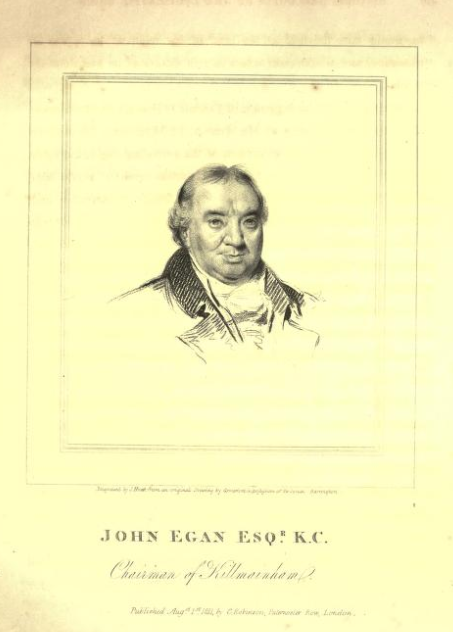

Historic Irish Barrister of the Week is John ‘Bully’ Egan, despite his name, size, and dueling reputation a kind-hearted, honest soul, who risked his career in opposition to the Act of Union and in defence of Irish Catholics. Below is an account of some intriguing elements of his life and character, comprised of extracts from various newspaper articles listed at the end of this post:
“Among the strange characters who practised at the Irish Bar, and occupied seats in the House of Commons at its close, may be fairly ranked John ‘Bully’ Egan KC.
Mr Egan was… born about the year 1750, and was the son of a clergyman, who kept a school. Having taken his degree as Bachelor of Arts in the University of Dublin, He resolved to study law and became a student in London. Here he found employment as a private tutor and also supported himself with his pen. He was called to the Irish Bar at Michaelmas Term 1778 and married a widow with a good fortune.
Egan’s practice at the early part of his professional career was chiefly acting as counsel in contesting elections. He acquired considerable practice at Nisi Prius and later served as Chairman of Kilmainham Quarter Sessions.
Egan was a burly man of large muscular figure, stentorian voice, and face like a full moon, but of so soft and good-natured a disposition, that he was never known to pass a severe sentence on a criminal without blubbering in tears.
He was, however, remarkably firm in shooting a friend. He perhaps fought more duels than any man on or off the Bench, both with swords as well as pistols, on one occasion interrupting a court case to fight one against opposing counsel, and, it is said, never received a wound.
He is reputed to have given his name to Bully’s Acre, a piece of free burying-ground, near Kilmainham, situated on a rising ground, at the back of the Royal Hospital, often used for dueling during that period.
One of Egan’s most celebrated duels was fought at Donnybrook with the Master of the Rolls, before a crowd of spectators, who were quite amused at the drollery of the scene. The Master fired, missed, and walked coolly away, saying his honour was satisfied; but Egan called out he must have a shot at his Honour. On the latter returning to his place, Egan said he would not humour him, or be bothered with killing him, but he might either come and shake hands or go to the devil. “I will do both together,” said the Master of the Rolls.
Another famous duel fought by Egan was with his contemporary John Philpot Curran. Both Monks of the Screw, Curran and Egan were usually good friends, yet they quarreled about the founder of their Order, Lord Avonmore. A meeting was arranged, and on the ground, Egan complained that the disparity in their size gave Curran a manifest advantage.
“I might as well fire at a razor’s edge as at him,” said Egan, “and he may hit me as easily as a turf-stack.”
“I’ll tell you what, Mr. Egan,” replied Curran. “I wish to take no advantage of you whatever. Let my size be chalked out on your body, and I’m quite content that every shot of mine which hits outside that mark shall go for nothing.”
Egan looked at him for a little time, and then said:— “After all I won’t humour you by firing at you, nor give myself the bother of killing you, so if you care to come and shake hands I’ll let you off without a shot.”
“Blaze away!” said Curran, “I’d rather you missed me with your pistol than touched me with your hand.”
There was, of course, a great amused crowd in attendance, and they were heartily enjoying the humour of the thing.

Curran and Egan were once on Circuit obliged to sleep together in a double-bedded room. In the morning, while changing his linen, Egan called Curran’s attention to his muscular appearance, boastingly exclaiming, “There’s a chest for you! —when will you be able to show anything like it?” “Pshaw” (replied Curran with the quickness for which he was so remarkable), “After all, it’s only an old trunk covered with calfskin!”
Another person less than impressed with Egan’s physique was the Archbishop of Dublin. Both men were fond of bathing at Blackrock. One morning, having flung his enormous carcase into the water, Egan came into collision with some other person similarly employed.
“Sir,” exclaimed a mouth out of the water, “I presume you are not aware against whom you have so rudely jostled.”
“I don’t care if you were old Nick,” replied Egan floundering about like a great sea monster.
“You are a bear, sir,” continued the mouth, “and I am the Archbishop of Dublin.”
“Well,” retorted Egan, not in the least abashed, “in order to prevent the recurrence of such accidents I would simply remind you to get your mitre painted on your back.”
As the above illustrates, Egan, like most Irish barristers of the time, was rarely short of a riposte.. On one occasion, alluding to the eloquent address of his opponent, a dark-visaged learned gentleman, Egan requested the jury “not to be carried away by the dark oblivion of a learned friend’s brow.”
“How can you use such balderdash?” remarked the studied lawyer. “It may be balderdash,” replied Egan, “but it depends on how it is said, for it was very well for the jury.”
On another occasion, having exhausted the usual vocabulary of vituperation, he concluded by describing the defendant as “a most non-frequented villain.” “What in the world do you mean by that?” whispered his astonished junior. “I have no idea,” responded Egan; “but I think it sounds well.”
Egan did however come off the worst in a verbal conflict with his old adversary the Master of the Rolls, when he observed, “if the latter did not leave off his abuse, he would put him in his pocket,” in allusion to his being a small man. “If you do so,” replied the Master, “you will then have more law in your pocket than you ever had in your head.”
Egan was on the right side of history more than once. In ’92 he presented a petition to the Irish parliament for some little concession to the Roman Catholics which was, alas flung from the table with contempt, with only two voting for it.
Egan also held the chairmanship of Kilmainham at the time that the government were using their utmost endeavours to pass the Act of Union, and, of course, expected to be deprived of his office if he should oppose it. However, when the time for the division had arrived, his love of country preponderating over his love of self, he voted against the measure, exultingly exclaiming, “Ireland forever! and Kilmainham to the devil!”
Perhaps because of his popularity with the public, or because of his dueling record, Bully never lost his office as a result.”
Sources: the Dundee Evening Telegraph, 4 March 1879, the Era, 2 May 1841, the Athlone Sentinel, 7 January 1842, the Freeman’s Journal, 12 November 1842, the Warder and Dublin Weekly Mail, 2 June 1843, the Dublin Evening Mail 3 March 1847, the Dundee Evening Telegraph 4 March 1879, Country Life, 6 April 1901, the Irish Independent, 15 April 1905, the Kerryman, 28 June 1906 and the General Advertiser for Dublin and all Ireland, Saturday, 19 May 1923.


Leave a Reply