
From the Northern Whig, 15 June 1912, a Welsh trial with a strong Irish connection and a remarkable twist to the tale:
“A HEAD-CONSTABLE’S ROMANCE.
SEQUEL TO A SECRET MARRIAGE.
Charge Against Belfastman
A VERDICT OF NOT GUILTY.
At Ruthin on the inst. Francis J. Waters, an officer in the Royal Irish Constabulary at Belfast, was charged with having, on the 25th August, made a false declaration for the purpose of obtaining a license for the solemnisation of marriage between himself and Beatrice Tyney, to the effect that he was a widower, had resided in Colwyn Bay fifteen days, and was by trade an ironmonger.
Mr. Artemus Jones, for the Public Prosecutor, said that prosecution was a sequel to a somewhat extraordinary secret marriage at Colwyn Bay in August last. Defendant in 1896 while an ordinary constable in Belfast, married a lady named Beatrice Maude Cromie. In1903 there was a mutual separation. Defendant rose to the position of a head-constable, and became acquainted with Mr. Joseph Tyney, of Sunny Hill, Knock, near Belfast, a manufacturer well-known in the district. He visited Sunny Hill, and, unknown to the parents, paid attention to Miss Tyney, proposing marriage. He told her that his wife had died on a voyage to South Africa, and that she had committed suicide on the voyage.
Miss Tyney resented all the overtures for a time, but eventually he persuaded her to be secretly married to him at Colwyn Bay. Miss Tyney left her home on August 15th, and defendant joined her at Colwyn Bay, engaging separate rooms. After communicating with London he interviewed Canon Roberts, vicar of Colwyn Bay, and swore the affidavit necessary for the provision of a special license, which involved a residence of fifteen days in Colwyn Bay before the marriage. The license was issued on August 22nd, and the parties were married on August 25th.
Hugh Davies Murphy, rector of St. George’s, Belfast, produced the register showing a copy of a marriage between the prisoner and Beatrice Maude Crombie in 1896. He had known the prisoner for twenty years, and in cross-examination said that he was known in Belfast as Frank Waters. In Ireland there was a necessity of residence for an ordinary licence, but not in the case of a special licence.
Thomas Joseph Smith, Commissioner in the R.I.C., Belfast, said that up to August last the prisoner received allowance as a married man. All members of the force under the district inspector required permission to marry. Prisoner before leaving Belfast in August did not apply for permission to marry. He knew he applied for leave for August 25th.
To Mr. Ralph V Banks (who defended), Commissioner Smith said that Waters worked his way up from the ranks and bore a very high character. Within a year or so he would be entitled to a pension, and if acquitted on these charges he would be reinstated. A complaint was made in consequence of an anonymous letter, and he had an interview with Mr. Tyney. Afterwards prisoner laid papers before him which proved he had done everything possibly to find out the whereabouts of his wife. In fact, he could not, in his opinion, have done more, letters being produced from police officers in all parts of the world. He knew Waters served his time as an ironmonger.
Inspector J. Fitzhugh Gelston, detective-inspector in the R.I.C., said that accused was on duty at Belfast on August 13th, He had known him for seven years, and he agreed that his character was admirable. He knew a solicitor inquired into the matter for the Tyney family, and they said they were satisfied.
His Lordship could not see what it had to do with the matter if other people were satisfied.
Mr. Bankes said but for other people stirring up trouble all might have been well.
Canon Hugh Roberts, St. Paul’s, Colwyn Bay, said that accused came to see him at the vicarage in August, and said that he required a license, and he filled in an affidavit in accordance with the statements made by him. Accused gave his residence as Colwyn Bay for fifteen days. On August 22nd, he married him to Miss Tyney, and after the ceremony filled in the entries in the register in accordance with the statements made to him by the accused, who described himself as an ironmonger and a widower.
In cross-examination, witness said that he had explained to accused what the marriage licence is, and he made reply that he did not mind extra expense at all. (Laughter.) There was no blank in the affidavit to fill in the fifteen days.
Witness was closely questioned by his Lordship as to whether fifteen days’ residence was mentioned as a necessary formality, and he replied that he carried out his usual practice. He did not tell him specifically it was necessary for him to be there fifteen days, but to his Lordship he said he had no doubt in his mind accused knew. He signed an affidavit to the effect that he had resided at Colwyn Bay for fifteen days.
An aunt of Waters’s first wife deposed that she last heard from her niece nine years ago, when she expressed her intention of disappearing after leaving her husband unless her fortunes mended.
For the defence Waters gave evidence on his own behalf. He said his first wife was driven from Belfast by anonymous writers, who made her life intolerable. Some time ago a mysterious visitor called at his office in Belfast and told him she had committed suicide on the road between Capetown and Johannesburg. Stranded through the railway strike at Colwyn Bay with Miss Tyney, when he had intended to marry in London, he received an anonymous letter which left him no option of honour but to marry her at once. The affidavit was read over to him by Canon Roberts, with a Welsh accent, which he, as an Irishman, failed to understand completely, the marriage customs being different to that prevailing in Ireland.
The jury found accused not guilty.”
One hopes things went well for the newly married couple, though it appears from a recently published biography that there was a Mrs Rochester lurking in the background, not in a dusty attic, but in the most splendid of Paris hotel rooms and South Coast Riviera mansions.
Head-Constable Waters’ first wife Beatrice Maud Waters, née Cromie, of Dungiven, County Derry, far from having ended her days on the road between Capetown and Johannesburg, had mended her fortunes beyond all reasonable hope or expectation.
She was, in fact, living in the height of Edwardian style as the mistress of newspaper tycoon Alfred Harmsworth, 1st Viscount Northcliffe, himself a son of an Irish barrister, in whose newspapers advertisements had been unwittingly placed by her husband seeking information about her whereabouts. It seems Head-Constable Waters never got a reply!
Beatrice, under the assumed name ‘Kathleen Wrohan,’ remained with the tempestuous Harmsworth until he died raving on a rooftop in 1921. The symptoms had been coming on for years; since the early days of their relationship she had been the only person who could calm him when he threw himself on the floor and bit the carpet. The couple had three children together, who may or may not have been adopted; Mrs Wrohan kept her secrets very close. Indeed, the circumstances in which she met her tycoon remain undocumented to this day. She did not long survive his death, dying, some said, of drink, a mere two years later at the relatively young age of 51.
Beatrice’s identity was traced by the understandably curious Harmsworth family as a consequence of a quarterly stipend paid by her to her aunt Isabella Maud Osborne in Northern Ireland. One suspects this was the same aunt who gave evidence in court in the above case that she had not heard from Beatrice in years.
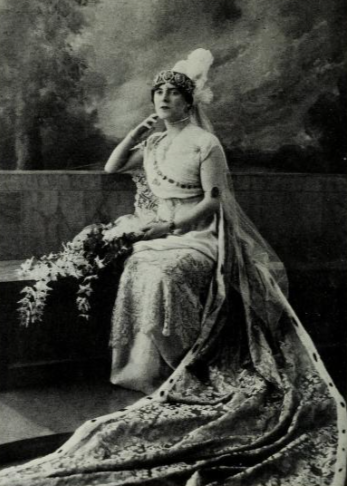
Beatrice’s life, in the end, was tragic, but there were compensations along the way; she was presented at Court, her ‘fleshy beauty’ showcased by ostrich feathers, and she also got to drive some very impressive cars; this photograph, from an earlier biography of Harmsworth, shows her at the wheel below, although, characteristically of a woman wishing to conceal her true identity, her head does not appear in the image. Was she protecting her own reputation, that of her family’s – or, out of remembrance of times past, leaving the path clear for her jilted husband to remarry?

We do however have a photograph of her presentation at court, which, from the Mata Hari style of her costume, would appear to date from around the time of the court case above.

The above two images are from Paul Ferris’s ‘The House of Harmsworth,’ 1972, via archive.org – an excellent read if you care to find out more about the mysterious Mrs Wrohan.
One final nugget from Head-Constable Waters’ trial – the prosecuting barrister, Artemus Jones, was himself the plaintiff in a famous libel action against the Sunday Chronicle, which you can read about here. Lawyers were often their own best customers!
Top Image Credit: Safari Island


Leave a Reply