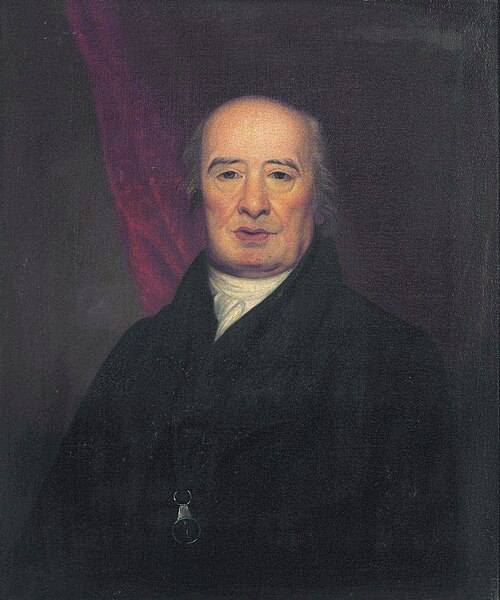

An account of the life of Irish barrister Thomas Addis Emmet (1764–1827), compiled from articles in the Shamrock, 19 May 1894; the Weekly Freeman’s Journal, 8 January 1898; the Freeman’s Journal, 14 September 1922; the Derry Journal, 3 March 1944; and the Evening Herald, 7 November 1961, all of which owe much to Madden’s The United Irishmen: Their Lives and Times (1842–1860):
“As long as Ireland has a history, the name of Emmet will remain indelibly imprinted in the heart’s core of her people. Thomas Addis Emmet, although less popularly known than his heroic and ill-fated younger brother, Robert, stands out pre-eminently in the story of the times with which we are here dealing as the most far-seeing and not least earnest of the Directory of the United Irishmen, and as one whose counsels, had they been followed, might have led their movements to a successful issue. Everything that Robert was, everything that Robert did, everything that had heroism in the final act of his heroic death on a gibbet in Thomas Street, was the result of his following in the footsteps of his elder brother. Thomas Addis was the model upon which the younger Emmet built his life.
Thomas Addis Emmet was born in Cork on the 24th of April 1764. His father, Dr. Robert Emmet, a physician of great eminence, moved to Dublin shortly afterwards. Old Dr. Emmet was an ardent nationalist, a supporter of Grattan and Flood, and of the Patriotic Party in the Irish House of Commons. He brought up his boys to love their country and to do everything possible to secure her freedom. Thomas Addis Emmet was, and at the age of fourteen entered Trinity College in 1778. Although his mental qualities were not, apparently, of the same shining character as that of his elder brother, Temple Emmet, or of his younger brother Robert, and though his oratorical efforts in the College Historical Society were unmarked by their bolder flights of poetic imagination and impassioned eloquence, they abounded in plants of a more enduring bloom—an impressive sincerity of conviction, manly scorn of subterfuge, and force of reasoning that occasionally arose to a display of eloquence apparently at variance with the coldness of feeling which his staid demeanour and contemplative cast of countenance would seem to indicate.

In 1783, he migrated from the University of Dublin to that of Edinburgh, there to enter on his father’s profession of medicine. In September 1784, he obtained his degree of Doctor in Medicine in Edinburgh; subsequently, he visited the principal medical schools of Great Britain, France, Germany, and Italy, and then in 1789 returned to Ireland, where, shortly after his arrival, by the death of his elder brother, Temple Emmet, his course of life became altered, and he resolved on embracing that legal profession of which his brother had early become one of the most distinguished ornaments.
He accordingly then proceeded as a law student to London, and after the usual formalities, after two years, returned to Dublin, where he was called to the Bar in his twenty-sixth year, in Michaelmas Term, 1790. A year later he married Jane, daughter of the Rev. John Patton, of Clonmel, who had recently moved to the capital after her father’s death. Before the wedding, Dr. Emmet had his house at No. 109 St. Stephen’s Green West, Dublin (subsequently Nos 124 and 125) divided into two for the purpose of providing accommodation for the young couple. Here the first child of the marriage was born in September 1792 and named Robert, after his famous uncle. Other children born were Margaret, in September 1793; Elizabeth, in December 1794; and John Patton Emmet, April 1796. A baby boy named Thomas was born before the Rising, and at a time when his father was deeply involved in the movement to set up an Irish Republic.

Following his marriage, Thomas Addis Emmet had rapidly won his way to a foremost position amongst the Junior Counsel at the Irish Bar, where he first distinguished himself in the case instituted by the United Irishman, James Napper Tandy, in 1794, against the Viceroy of Ireland, in reference to a proclamation issued by the Earl of Westmoreland, as Lord Lieutenant, for the apprehension of Napper Tandy. The object of their proceedings was to contest the validity of the Lord Lieutenant’s patent, as having been granted under the Great Seal of England instead of the Chancellor of Ireland. The object, however, was disclosed to the Crown lawyers, and Tandy’s advocates were obliged to bring forward the main question prematurely. On that occasion, Thomas Addis Emmet, counsel for Tandy, spoke in the following terms on the point referred to: —
“I boldly assert that there has been no legal Viceroy in Ireland for the last 600 years, and not only the counsel for Lord Westmoreland will not deny that fact, but they will not dare to let his patent come under a train of legal investigation.”
Leonard M’Nally, the barrister, was the person suspected by Tandy’s counsel of having betrayed his friends on that occasion by disclosing their object to the Crown lawyers, who had been previously ignorant of it.
Thus, was commenced Emmet’s connection with the United Irishmen, which was more singularly manifested when, in 1795, being engaged in a motion for arrest of judgment in the case of some persons convicted of administering the United Irishmen’s oath, then a capital offence, Mr. Emmet appeared for the prisoner. On that occasion, Emmet having read the text to the court, defended the obligation with an amount of reasoning and legal knowledge respecting the distinction between legal and illegal oaths, which produced an extraordinary impression. He then addressed the court in the following terms:—“My lords, here in the presence of this legal court, in the presence of the Being that sees and witnesses and directs this judicial tribunal—here, my lords, I myself, in the presence of God, declare I take the oath.” He then took the book that was on the table, kissed it, and sat down. No steps were taken by the Court against the newly sworn United Irishman. The amazement of the legal functionaries left them in no fit state of mind either for remonstrance or reproval, and the prisoners received a very lenient sentence.
In 1796, he became an active member of the Association, and in the following year joined the Directory. At that moment, the councils of the United Irishmen were distracted and divided on the question of risking an immediate attempt on their own resources or deferring that attempt until the assistance promised by France had been given to them. In favour of the former course were Lord Edward Fitzgerald, Arthur O’Connor, and Henry Jackson, whilst on the other side were T. A. Emmet, M’Cormack, and M’Neven. The application to France had been made before Emmet joined the Directory. In March 1798, the Government, having allowed the plans of the United Irishmen to come to a sufficient degree of maturity for their purpose, availed themselves of the services of a man whose very name sounds in one’s ear like a calamity, viz.—Reynolds, the informer. Most of the deputies were arrested on his information.

On the night of March 12, 1798—the day on which Oliver Bond’s house in Dublin had been raided and most of the United Irish leaders arrested—Jane Emmet and her husband were in the nursery taking their little children in their arms and giving them their good-night kiss, when there was a loud banging at the hall door. The maid opened it, and one of the Orange leaders of the town, Alderman Carleton, with an escort of soldiers, rushed up the stairs, rudely invaded the nursery, and carried away the children’s father. Against Thomas Addis Emmet there was no specific charge, no overt act of treason brought against him, though he was looked on as the prime mover in the conspiracy, as well as the legal adviser of the United Irishmen, of the leaders of whom there were at that moment no less than twenty confined.
Thomas Addis Emmet was brought to Dublin Castle for questioning and later committed to Newgate Prison with the other State prisoners. The cell in which he was confined, according to Dr. Madden, was 11 feet square—a very small space for any human being to live in. But it was not only one person who lived in that cell. Two people lived there and were forced to subsist on the rations of one; for Jane Emmet had managed to bribe one of the jailers and was for a week an inmate of her husband’s cell before the authorities discovered it. When she was discovered, she refused to leave, and because the Emmet family were so well-known in the city, and so highly respected, the Governor of Newgate hesitated before handling this lady roughly. She stated flatly that she would not leave the cell unless she was ejected by force. Force was not used; Mrs. Emmet was allowed to remain with her husband. But the Government refused to supply any food to her or to allow her friends to send in food; husband and wife were forced to live on the meagre quantity supplied to sustain the life of one prisoner.

During the first seven months of his captivity, Mrs. Emmet remained with her husband in his cell, but once during that period she left the prison and returned to it. She had got word from her mother-in-law that one of her children was ill. The same friendly warder who had smuggled her in, in the first instance, succeeded in getting her out, allowing her two hours to visit the home in St. Stephen’s Green. Having assured herself that the baby would be all right, the warder succeeded in getting her back into prison again. In due course, however, Jane was forced to leave Newgate. At the end of her seventh month there, it became apparent that she was going to have another baby. The new baby was called Christopher. After the birth of the baby, the Government made it impossible for Mrs. Emmet to return to prison.
By this time, the Rising in Kildare, Wexford, Antrim, and Down had been crushed. It was with a view of preventing any further useless effusion of blood that the still untried leaders of this party entered into negotiations with the Government. The conditions that were thus agreed on were a suspension of hostilities and reprisals on both sides, and, secondly, the freedom of the leaders, subject to them at once quitting the country. The terms of this compact, however, were immediately violated by the Government. The punishment of the insurgents and oppression of the people continued, and Thomas Addis Emmet, with the other leaders, were transmitted to Fort George, in Scotland, where they were detained in imprisonment from the 9th of April 1799 until the middle of June 1802. Mrs. Emmet was permitted to rejoin her husband in Fort George, and life there was tolerably comfortable after the cell in Newgate. The Governor of the Fort was a chivalrous old Scottish nobleman and soldier named Colonel Stewart.
After an imprisonment of three years in Fort George, and of one year in the Dublin prisons, in violation of a solemn compact, the Government determined on the liberation of the prisoners, and accordingly Thomas Addis Emmet and the other State prisoners were embarked for Cuxhaven on the 30th of June 1802, and landed in Holland on the 4th of July. During the sojourn of Jane and Thomas Emmet in Fort George, they had been separated from the three young children, who had been left behind in Dublin with their grandparents. They did not rejoin their parents until they were leaving for Brussels. While at Fort George, Jane Emmet’s seventh child was born, and because they were exiles from Erin, they called the little girl Jane Erin Emmet. That autumn and winter the Emmet family passed in Brussels. It was in Brussels that Thomas Addis Emmet heard of his father’s death, and it was in that city, too, that he was visited by his brother, Robert, then on his way to France to seek aid from the Emperor Napoleon for a new Rising in Ireland. Thomas Addis Emmet was fully aware of, and approved of, Robert’s plan. It was therefore a terrible shock to him when the news came from Ireland that Robert had failed and had been executed.
The greater part of the following year he resided in Paris, where he was in correspondence with the French Government on the subject of their prompt assistance to the Irish cause. In the autumn of 1803, T. A. Emmet had an interview with the First Consul. On the 13th of November he addressed a memorial to him, and on the 13th of December following, Bonaparte replied to this communication, declaring his intention to set on foot preparations for an expedition to secure the independence of Ireland. Earlier in the same year, many of the United Irishmen who had gone to France formed themselves into an Irish battalion, or legion, under the command of General M’Sheehy, and there is no doubt most of them would have returned to Ireland with an invading expedition, which they were led to believe was then actually fitting out at Brest and elsewhere.
After some months of anxious suspense and vain hope, it became apparent to the best-informed of the Irish delegates in France that little reliance could be placed on Bonaparte’s promises of effective assistance to the Irish cause. And ultimately, therefore, on the 4th of October, Emmet, accompanied by his wife and daughters, embarked at Bordeaux for New York, where he arrived on the 11th of November 1804.

From the time of his arrival in America, however, although still retaining an undying attachment to his native land, in the cause of which he had sacrificed so much, and to the principles of his youth, he devoted his energies to the affairs of his adopted country, and so passed out of the troubled realm of Irish politics. A warm friendship sprang up between him and the Irish American Governor, George Clinton, and his nephew, De Witt Clinton, Mayor of New York. The historian Haines, referring to the obstacles with which Mr. Emmet had to contend, and the masterly way in which he surmounted them, says:
“Mr. Emmet’s strong and decided attachment to democratic principles was known even before he reached the American shores. Coming to a country where he could breathe and speak freely, he did not find it necessary to repress those bold and ardent sentiments which had animated his bosom while toiling for the emancipation of Ireland. He mingled in the ranks of the Republican party. Transatlantic politics, it is well known, had extended their agitation and influence to that country. The Federal party hated France, hated Ireland in her revolutionary character, and hated Charles James Fox and his Whig party in England. Mr. Emmet was viewed by the opponents of Mr. Jefferson’s Administration as a fugitive Jacobin. Hence, he was doomed to some little persecution even in that country. The great men of the New York Bar were Federalists. They, therefore, turned their faces against Mr. Emmet. They formed a combination and agreed to decline all professional union and consultation with him.
When Mr. Emmet ascertained the existence of the league he did not hesitate what to do. His native boldness and decision of character governed his conduct. He determined to carry the war into the enemy’s country. He did not wait for an attack. He proved the assailant. Whenever he met any of the league at the Bar he assumed the attitude of professional war, and he lost nothing by contact. If Mr. Emmet has any one extraordinary power, it is the ready talent of successful and over-awing reply. His spirit is always dauntless. Fear he never knew. Hence, he gradually came off victorious in the wars against the combination. The league was soon dissolved. Business flowed in, and Emmet assumed a standing, and was able to maintain it, that put all opposition at defiance.
Crowned with professional success, and full of honours as of years, Mr. Emmet was seized with an apoplectic fit in the United States Circuit Court on Sept. 14, 1827, and died soon after being carried to his home. The different courts were adjourned, and his funeral was attended by the members of the Bar, students at law, the City Council, and large numbers of citizens of every walk in life. In remarkable contrast to the nameless tomb in Dublin which encloses the remains of the ill-fated Robert Emmet, the splendid monument erected to his memory in St. Paul’s Churchyard, Broadway, New York, in December 1832, is a proof of the estimation in which he was held by his countrymen.
It was erected in 1829 and consists of a monolith of thirty feet elevation, standing in front of Broadway in the cemetery of St. Paul’s Church, and is inscribed at great length in English, Latin, and Irish, with a full record of Emmet’s claims to the esteem of his contemporaries and the remembrance of posterity.

Thomas Addis Emmet’s wife Jane survived him by 19 years. She died at the home of her son-in-law in New York on Nov. 10, 1846, a year before the Great Famine in Ireland and two years before the Young Irelanders made another bid for freedom. Her descendants and those of her husband have to the present day perpetuated the high qualities which were the characteristics of Thomas Addis Emmet.”

One of these descendants, their grandson, Dr. Thomas Addis Emmet, left a will requesting that he be buried in Glasnevin Cemetery, Dublin, Ireland, stating that:
“As I grow older, my desire becomes stronger to rest finally in the land from which my family came,” further adding that “God has done more for Ireland than for any other favoured territory of the same extent, and nowhere has man done so little. Intellectually, God has favoured the Irish people as individuals, and scattered over the world at large, no other race has done more for the development and happiness of other people. Comparatively, England is in the decrepitude of old age, and justice England must some time become an Irish province. This belief is a family inheritance.”
Today, the name of Thomas Addis Emmet appears on a memorial in the Four Courts, Dublin, commemorating those barristers arrested at the time of the 1798 rebellion. In 1799, two of those men, Emmet and Arthur O’Connor, had been disbarred by the Benchers of the Honorable Society of King’s Inns. In 2015, the Inner Temple—one of the four Inns of Court in London—reversed the disbarment of the Indian nationalist lawyer Shyamji Krishna Varma, who had been punished in 1909 for his advocacy of Indian independence; is it time to do the same here?


Leave a Reply