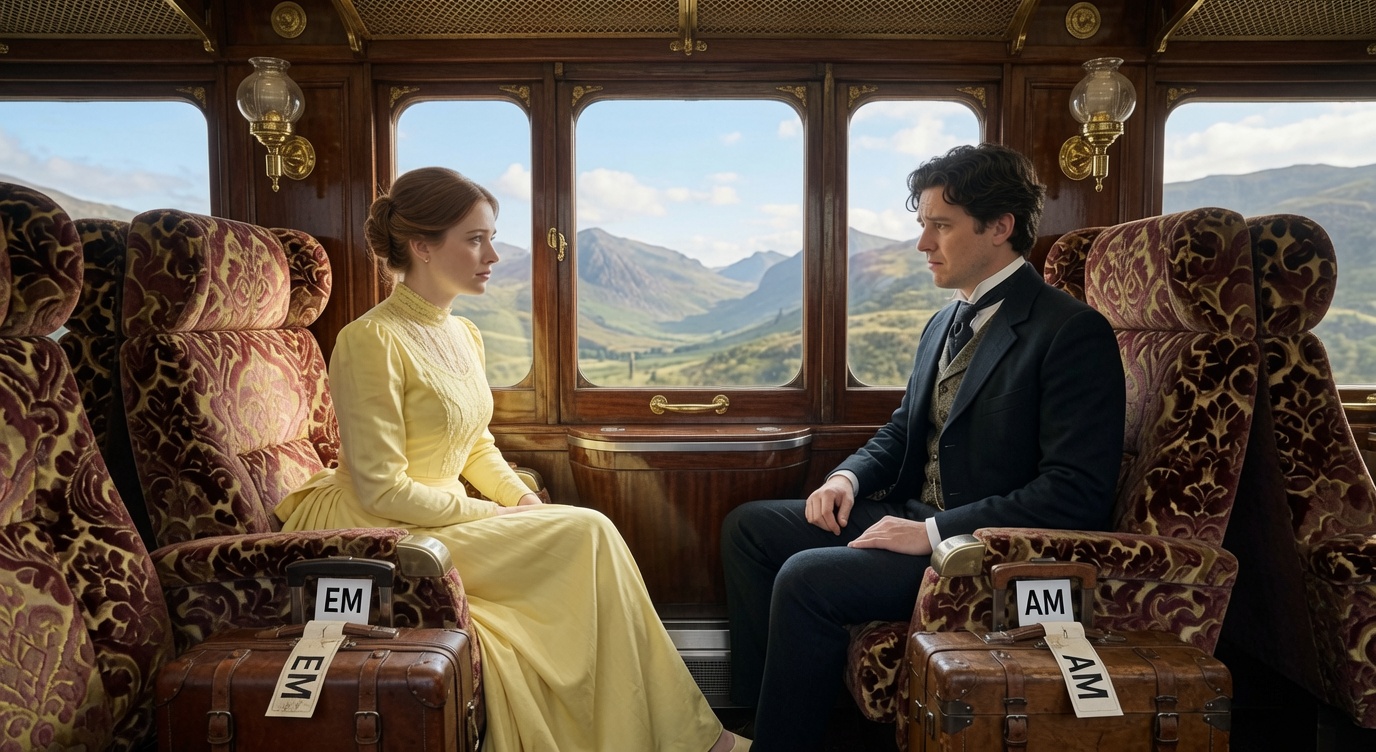

Parts II and III of the entertaining fictional series, ‘A Junior Barrister,’ from the Lady of the House, 1896, reprinted in the same publication in 1910, about the marital vicissitudes of Arthur Morris, a young Irish barrister practising in the Four Courts, Dublin, Ireland in the last decade of the 19th century, and his very new wife Eveleen.
Missed Part I? Catch up on it here first…
“CHAPTER II.
Mr. and Mrs. Campbell were cheered by getting rid of a difficult and expensive daughter, but their contentment was somewhat marred by Eveleen’s determination to have a “smart” wedding. In vain her parents represented that many persons of much higher social standing were married quietly.
‘Lily Newton had a quiet wedding,’ said her mother, ‘and you know the Newtons are much better off than we are.’ ‘It’s just because Lily Newton had a quiet wedding that I am determined that I won’t have one,’ answered Eveleen snappishly. ‘She’s inclined to give herself airs, just because her husband has been taken up so hotly by a K.C., but I’m determined to let her see I’m not going to do things her way. It’s the last thing you’ll have to do for me, mother, and you may as well do it properly. Besides, if I was to get married shabbily, everyone would say you couldn’t afford to give me a decent wedding.’
This unanswerable argument settled the matter, as Eveleen meant it should, and Mr. and Mrs. Campbell, after the usual manner of needy Dublin householders, rushed still further into debt lest it might be suspected they found it difficult to pay what they already owed.
From the time that Arthur had prevailed on Eveleen to marry him with as little delay as possible, she spent her entire time in shopping and ‘trying on.’ Arthur would have liked to have a voice in the selection of the dresses in which he was constantly to see her the next year of her life, but this was a matter he did not like to mention. In the selection of his furniture, however, he did expect to be consulted, but though he was, of course, always present, it seemed to him that Eveleen was more willing to take the advice and adopt the taste of the shop attendant than his own.
‘I think we might ask your mother to come with us some day,’ he ventured to suggest one afternoon, when Eveleen, in opposition to his expressed opinion, had insisted on choosing some rather gaudy drawing chairs. ‘These are the same as those selected by the Hon. Mrs. Blarney,’ the shopman had said, and Eveleen had decided on them at once.
But she would not hear of her mother’s accompanying them. ‘Mother has the most antiquated ideas. She’d want you to buy a walnut suite with green rep covering.’
And so, at last the furniture was chosen, of a perishable and gimcrack kind, in Arthur’s opinion.
‘I think, dear,’ he had remonstrated, ‘that as these things are to last our lifetime, it would be wiser to select a more solid style.’ ‘Oh! don’t threaten me with looking at the same furniture for the rest of my natural life. That would be too dreadful. Oh, no, it’s much better to do as we have done, and get cheaper things. Then we can change them more easily afterwards.’ But when the bill for the cheaper things came in, Arthur found it quite as high as he cared for.
‘Mother is writing to Aunt Alicia,’ said Eveleen, the next time they met, ‘to ask her to come to the wedding. She is a great old oddity, but it wouldn’t do to neglect her. You know, I’m supposed to be her favourite.’
Aunt Alicia’s answer, however, was rather disappointing. She would not come to the wedding. She considered a wedding of the kind quite unsuitable for a man in her brother Robert’s position; nor did she think that such fuss and harry conducted to either bride or groom’s entering into such a solemn engagement in at all a proper frame of mind. She enclosed a cheque for £5 and hoped that Eveleen would have the good sense to employ it wisely. If she might make a suggestion, she considered sheets and blankets a profitable investment. ‘Stingy old cat,’ was her affectionate niece’s remark on reading this friendly advice. ‘I expected she would have sent at least twenty.’
The day but one before the wedding, Arthur called late in the evening, hoping to have a quiet time with Eveleen. A sound of feminine voices, pitched in an extremely high key, greeted him, as the shabby servant opened the door of the dingy drawing-room. ‘Oh, how sweet!’ ‘That shade will be so becoming to you, dear!’ ‘I must say I like that hat!’ ‘Did you really think that blouse all by yourself!’ ‘Well! your things are ever so much nicer and more tasteful than Selina’s,’ were among the sentences that met Arthur’s ear as he entered the room, and found it crowded with Eveleen’s female acquaintances.
He would have retreated in silence if the eye of his beloved one had not lighted on him at the critical moment. ‘Come and look at my things, Arthur,” she called out. “I forget you hadn’t seen them yet.’ The miserable Arthur advanced under the fire of five pairs of female eyes and looked over the garments with which the shabby furniture was covered with the lack-lustre eye of the average man.
‘I’m sorry you’ve got a yellow evening dress,’ he said in a whisper, as he passed before an elaborate ‘confection’ of silk and gauze, “you know I hate to see you in yellow.’
‘Well, really, Arthur, you can scarcely expect me to make a fright of myself on account of an absurd prejudice. Everyone but you considers yellow my most becoming colour.’ ‘I think you look better in any other,’ he answered, and presently, with a vague feeling of annoyance and disappointment, he took his leave.
As he walked home through the deserted streets, he asked himself if he could be expected to welcome these female friends of Eveleen’s to their house when they were married. He hoped not. ‘If they were girls like herself,’ he thought, ‘or even like Kathleen Blake, but I don’t know how she can care for the company of people like that.’
The wedding was quite a brilliant affair. The church was at least a quarter filled with curious idlers. The society papers reported the following week that ‘the bride looked lovely in a dress of white duchesse satin,’ etc., etc. The little drawing-room, the hall, and staircase were crowded to suffocation the whole summer’s afternoon. Mr. Campbell tried to look as if he was quite clear in his mind as to where the money to pay for the entertainment was to be found. Mrs. Campbell skilfully disguised her dismay on discovering ‘the man’ brought in to help the maid-of-all-work in the pantry in a fairly advanced stage of intoxication, when he should have been opening the door for the guests.
‘How glad I am to have you by yourself at last,’ said Arthur to his wife, when at length she had run the gauntlet of her friends, and they had departed from the parental hall-door in a shower of rice and slippers, greatly to the delight of the genius who lined the pathway. ‘I thought the whole thing would never be over. Are you tired, darling?’ he added, tenderly venturing to put his arm round her and draw her toward him. ‘Oh, a little, of course,’ answered the bride, stifling a yawn, ‘but it had to be done properly, and I think everything went off very well. The bridesmaids all looked well, I thought, except Kathleen Blake. Mauve makes a show of her. Take care of my hat, dear, the flowers are very perishable, and it is rather expensive. I bought it with Aunt Alicia’s cheque.’
CHAPTER III
‘I see the Morrises are back,’ said Frank Blake to his sister, as they sat at breakfast one hot August morning.
Miss Blake, who was bending down to give her dog his usual meal, did not answer for a moment. When she did, her face was flushed, probably from stooping.
‘Oh, yes. I knew they should be home about this time. I met Mrs. Campbell the other day, and she told me. Poor woman, she looks much tired and worried than ever.’
‘I should have thought that getting the fair Eveleen off his hands would be a relief.’
‘I dare say it will be, when they recover a little from the wedding expenses.’
‘What folly! people in their position giving an entertainment. What can they expect to gain by such extravagance!’’
‘I imagine the father and mother had very little voice in the matter. It was probably done to please their daughter. I think you might to call at once on the Morrises, Frank, on account of your having been best man.’
“I’ll not go without you. I’m not going to have to listen to Mrs. Morris’s account of her visitors and dresses.”
“If you go at once, she will scarcely be able to entertain you with a list of the first,’ said Kathleen, laughing, ‘and I must say it is like a man to leave the disagreeable part to his sister.”
“Well, Kathleen, to tell the truth, I’ve a special reason for wishing you to come. ‘I’m not quite easy to my mind about Arthur’s menage. I’ve a poor opinion of the fair Eveleen as a housekeeper, and I thought that you could give her a hint—’
“Really, Frank,” cried Miss Kathleen, a little hotly. “I think you can scarcely expect me to set Arthur Morris’s house straight for him. He has married with his eyes open, and surely, she is the proper person to manage his affairs.’
She turned away as she spoke and occupied herself with a gigantic palm which stood in the window, and which was one of her few extravagances. There were other plants both in and outside the window, but they were of the less expensive kind. Her brother looked at her with an expression of thoughtful surprise in his grey eyes; he was not used to see her lose her temper.
“All right, Kathleen,” he said at last, pulling his long moustache. “If you don’t care to come, don’t. I only thought that as poor Arthur is only making much about the same as myself, you might be able to make things easier. I should have remembered too, dear,’ laying his hand gently on her shoulder, ‘that I don’t earn all the money that keeps us going.’
‘Never mind about that,’ in a softened tone, ‘but if you really make a point of my going with you of course, I go. I’d better get to work though; I’m wasting the whole morning. I’m wearing the whole morning. Dear me, it’s very hot. We ought to be lying out under a tree, Frank, taking no thought for tomorrow, at this time of year, but unfortunately these days haven’t come on for us yet.’
‘They will come, be sure,’ said her brother, “and perhaps sooner than we expect; remember ‘heaven helps those who help themselves’.
Kathleen burnt out laughing. ‘What is the matter with you this morning, Frank, that you entertain me with stale platitudes.’
‘I don’t know, I’m sure; I fancy I’ve got Arthur’s household on the brain.’
‘I fancy Arthur’s household will have to take care of itself; let you and me try to help as much as we may. Good-bye now. I mean really go this time, or the whole morning will be wasted.”
Arthur and his wife had spent the honeymoon at Llandudno. Arthur had suggested a quieter place, but Eveleen had swept away his sentimental objections with the besom of common sense.
‘Oh, yes, dear; let us go to some quiet retired spot where we’ll never see anything or anybody but each other. I just give us three days to get heartily sick of it. Oh, no, Arthur, believe me there’s nothing preserves respect and affection between married people better than seeing as little as possible of one another tête-à-tête.’
So Arthur had consented to Llandudno with a mental reservation in favour of daily excursions into the more remote parts of the country. He found, however, that Eveleen was just as much opposed to any solitary expeditions as she had been to a quiet honeymoon.
‘My dear Arthur, do give up these old-fashioned ideas. You can hardly believe how many marriages I’ve known to turn out failures, simply because people didn’t recognise the necessity of seeing their fellow-creatures.’
His suggestions that they should at last go off for a day and see something of the mountains met with equally little success.
She hated climbing, and mountain scenery made her depressed, besides, it was always raining up among those hills.
Arthur resigned himself to continual promenades in the full glare both of the sun and of public inspection. To his dismay, they met (it seemed to him) nearly all their Dublin acquaintances, and they met some new ones, which gave more pleasure to Eveleen than to himself.
Among these new friends was a Mrs. Johnston Smith, a tall, large woman, with an unusual quantity of flaxen hair, and an unsuitably girlish manner. Arthur objected to her strongly, and yet more strongly to her constant companion, who was generally known as Captain Parker, but who was always addressed by Mrs. Johnston Smith as “Charley.”
This gentleman, who was short, rather stout, and red in the face, was chiefly remarkable for his capacity for imitating the barking of dogs, the miawing of cats, the crowing of cocks, and the squeaking of mice. By the exercise of this invaluable gift, he kept his companions in a constant state of innocent amusement, especially when nervous old ladies happened to be in the neighbourhood.
‘Goodbye,’ said this distinguished individual, as he and Mrs. Johnston Smith saw their friends off at the close of the honeymoon; “awfully glad to have met you, really. Sure, I hope we’ll see you in Dublin.’
‘Good-bye, dear,’ echoed Mrs. Johnston Smith, ‘I’ll send you word directly I get back, and I will send you a card for my Wednesday. I hope we’ll see a great deal of each other next winter.’
‘And I hope we’ll do nothing of the kind,’ said Arthur, as he settled into the corner opposite Eveleen. (They had sat side by side on their way from Holyhead, three weeks before).
‘Why not?’ asked his wife, a little sharply; ‘I must say I’m looking forward to her ‘at homes.’ They must be very interesting; she always asks all the actors and distinguished people that come to Dublin. Captain Parker told me—’
‘Oh, Eveleen, do let me have a rest from Captain Parker; if I could only tell you how sick I am of that man.’
‘I think he’s extremely amusing; but I’m beginning to notice, Arthur, that you and I seldom care for the same people.’
It was the nearest approach to a quarrel that they had had as yet. Indeed, poor Arthur had given up his own way so meekly and willingly all through, that it would have been hard to fight with him. They were silent till they got to Holyhead, where Eveleen, inspecting the luggage on the platform, observed that there wouldn’t be a soul in Dublin when they got back.
‘We should have put off our wedding for a month or six weeks,’ she said, ‘then we should have gone away and come back with everyone else.’
‘I didn’t think about everyone else. I thought only of you and me,’ answered Arthur, who was watching the exodus of Q.C.’s and prominent juniors by the mail train, which was then starting, and wondering if they would stay away long enough to throw any stray crumbs of business in his way.
When they reached their small house in Cedar Place, they found everything ready to receive them, thanks to poor Mrs. Campbell’s exertions. Eveleen, as she sat for the first time at the head of her own table, asked Arthur if he did not see now how much better it was to have a house of their own.
The next day but one, Frank Blake and his sister found Arthur in his shirt sleeves on a ladder, hanging pictures under Eveleen’s directions.
‘Oh, I’m so glad you’ve come,’ said Arthur, when congratulations and greetings were over. ‘I want you to tell us whether we ought to put ‘The Peacemaker’ under or over the ‘Angelus.’ They’re both wedding presents.”
This matter settled, Eveleen drew Kathleen aside.
‘Would you cover that flowerpot with Liberty muslin or crinkled paper?’ she asked, pointing to a pot containing a scarlet geranium.
‘With neither,’ Kathleen answered promptly. ‘A clean-scrubbed red earthenware pot looks much better than wisps of paper or muslin.’
Eveleen made no answer, but on Kathleen’s next visit she saw with some little amusement that Liberty muslin had carried the day.
‘Come upstairs,’ was Eveleen’s next remark, ‘I want to consult you about altering the body of my wedding dress.’
‘The Morris ménage seems to be doing well, Frank,’ said Kathleen to her brother as they walked home together. ‘I was glad to see Arthur taking an interest in making the house pretty.’
‘Yes,’ answered her brother, with an extra-long pull at his moustache, ‘but he told me his wife is angry at being in Dublin in August, and that he didn’t know where the money to pay for the furniture was to come from.’
TO BE CONTINUED…”
Image by Grok.


Leave a Reply