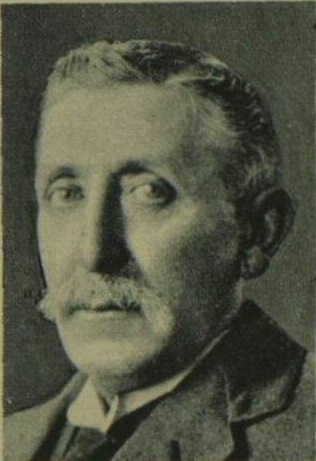

A fascinating and eminently readable account by Jack Allen, published in the Belfast News-Letter of 28 June 1966, about midlife legal career re-inventor and Wilde cross-examiner Edward Carson, and how he overcame professional struggles following his transition from the Irish to the English Bar:
“Carson’s gown
“What have sausage skin dressers to do with seamen?”
The man who knew the answer to that one now looks down in gilt-framed majesty on the deliberations of Mr. Hogarth and his executive from a place of honour above their conference table at Seamen’s Union headquarters.
It is a picture of their founder, Joseph Havelock Wilson, M.P., a Victorian father-figure of bearded rectitude (image below right). A different picture was seen one July day in a Guildford courtroom, the proud figure, bent and trembling, the noble beard spattered with tears.
The man who struck water from that rock was Edward Carson, then a junior of only a few months’ standing at the English bar. And the rod that achieved the miracle was the question quoted above. The year was 1893.
That he was then still only a junior barrister was something of a scandal, for Carson had in fifteen years at the Irish bar achieved high distinction. Though an Irish QC, and an ex-Solicitor General, his application for silk had been refused by the Lord Chancellor, who declared that, according to precedent, the applicant must wait another nine years. But the key to unlock this barrier and set young Edward Carson on the road to high office and higher renunciation was to be provided by Mr. Havelock Wilson.

Fiery orator
In Tyneside that fiery orator had founded the first seamen’s union, and built it up in six years to a membership of over 65,000.
Finances were precarious, for the members were poor men and subscriptions were small. Yet Mr. Wilson, newly-elected M.P. for Middlesbrough and a rising man in the Labour movement, had run amok, the previous year, advocating shipping strikes up and down the country.
These activities aroused the interest of the Evening News, and the result was an article entitled ‘A Financial Scandal’, criticising the administration of the union, alleging that its funds had been disbursed in a ‘reckless, wasteful, extravagant, mysterious and unintelligible way.‘
Libel suit
It was also suggested that Mr. Wilson had deliberately engineered a strike to force an inquiry into the financial position of the union.
Havelock Wilson sued for libel, claiming £7,000 damages. The Evening News engaged Edward Carson, and the case was heard at Guildford Assizes by Mr. Justice Grantham.
Havelock Wilson, surrounded by friends and colleagues, seemed quite at ease.
Carson’s cross-examination began on a gentle note, and Havelock Wilson, in a court thronged with friends and colleagues, was equally polite.
Yes, he had founded the union in 1887; his salary was only £2 a week; he had little to do with finances, being concerned with policy. Regretfully, there had been some defalcations on the part of collectors.
Carson then turned to Mr. Wilson’s election expenses: £201 at Deptford, £506 at Bristol. “About £5 a vote,” commented Mr. Wilson sadly.
“Middlesborough was better… 500 donation”
But Edward Carson preferred to talk about Bristol.
“You say in your declaration, your sworn declaration, that your expenses had been £400 odd?“
“Yes.”
“Yet in this balance sheet there is £500 odd donated by the union for expenses there?”
“Yes – I cannot explain that.”
“You also say that no club or association paid anything for you. How do you explain that?“
“I did not think there was anything illegal in that at the time.“
Carson then went over the balance sheet, showing that the union could not meet its liabilities, and invited the plaintiff to agree that it was ‘a document of financial effrontery.’ He went on to deal with the most serious libel, that Havelock Wilson had called a strike to burke inquiry into the finances.
“Was there a strike?“
“Yes.“
“Did you say at a meeting that if there were not a strike you would be ruined?”
“No, I do not think so.”
“Did you say you were liable to £600 on bills?”
“I said I had received money from friends, which I had paid on behalf of the union, and that I was liable for these sums.”
‘Strike pay’
Next day the advocate turned the rule book. “Is there any rule authorising you to give strike pay to members of another union?”
“No.”
“Are you in the habit of giving large sums to other unions?”
“Yes.”
“On your own authority?“
“Yes.”
“What’s the use of laying down a rule, and then handing the union’s money to strangers?’
“I do not know.”
“Did you not give the Sausage Skin Manufacturers Union £50?”
Wilson confessed that he had, and Carson sought in vain for a link between sausage skinners and seamen, while the court rippled with laughter. Then, magically, he found it.
“Ah, was not this union in Deptford, where you were a candidate?”
Mysterious characters
The end came when Carson introduced the matter of union money paid to three mysterious characters who had been witnesses at the Parliamentary Labour Commission.
‘Why is one of those men in court today?’
Havelock Wilson could take no more; he was led weeping from the court.
Next day, the coup de grace. Of the total £5,000 paid in ‘benefits’, £2,000 were for legal expenses, and of this £600 had gone to Mr. Havelock Wilson himself, to pay for a criminal prosecution he brought against a fellow-member who had called him ‘a thief, a villain and a rascal.’ Worse, the man had won his case.
Farthing award
There was little more to be said. The jury brought in a verdict for the Evening News, with costs. On a technical libel they awarded Mr. Wilson a farthing.
The results of the case were far-reaching. Rarely had a civil action aroused such interest; rarely had any counsel achieved such renown for his conduct of a single case.
The silk gown could no longer be withheld, and within a few years Carson was leading counsel at the English Bar, a glittering future before him.”
Image Credits: Belfast News-Letter and Wikipedia.


Leave a Reply