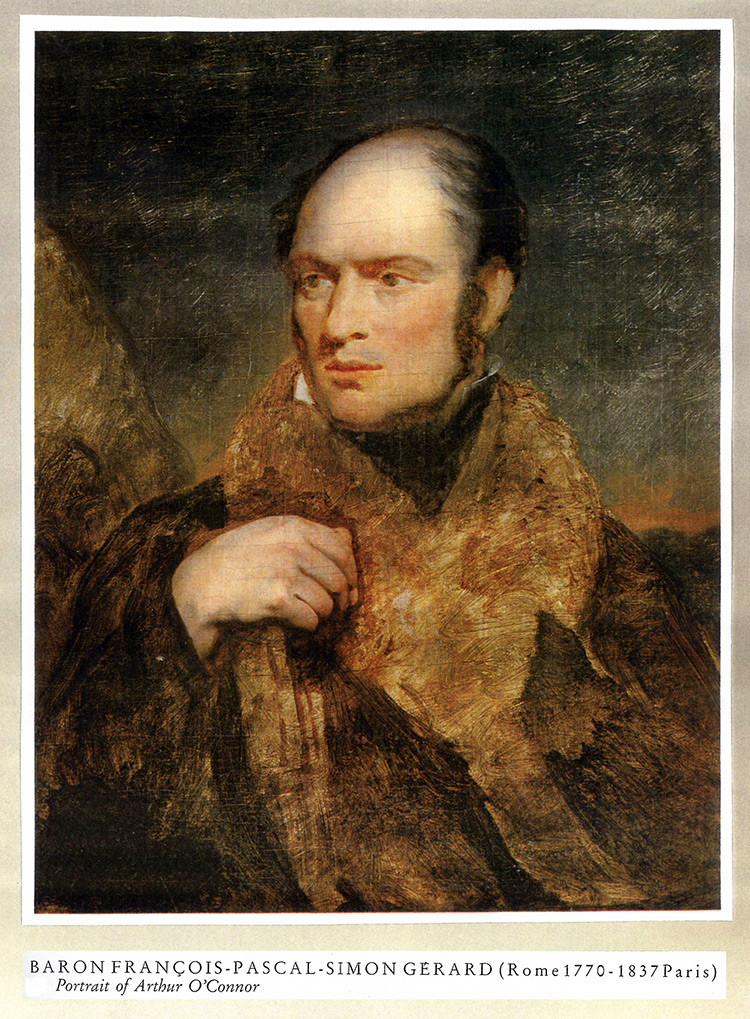

Compiled from the Illustrated London News, The Sketch, Advocate, Dublin Evening Telegraph, Connaught Telegraph, London Daily Chronicle, Evening Herald (Dublin), Daily Gazette, Weekly Dispatch, Ashbourne News Telegraph, and Kerry News, this account of the life of Irish barrister Arthur O’Connor, yet another 1798 rebel who found fame and fortune abroad after arrest and imprisonment, ending his days in a magnificent château in France:
“A Rebel in His Own Land; a General in Another
One of the ablest members of the United Irish Party during the trying days of 1798 and thereafter was Arthur O’Connor, who later became a noted general in the French army. He was born at Mitchelstown, County Cork, on 4 July 1763.
After receiving an education at Trinity College, he chose the legal profession and was called to the Irish Bar. In 1791, O’Connor was elected to the Irish Parliament as MP for Philipstown. He soon placed himself at the forefront of those Protestants who were most opposed to the proceedings of the Government in Ireland. This course of conduct was so contrary to the wishes of O’Connor’s uncle, Lord Longueville, that the nobleman offered him the reversion of his estates, with the prospect of succeeding to his title, if he would abandon his democratic principles. O’Connor steadfastly refused to do so. His parliamentary career was so promising that Pitt offered him a position under the English Crown in an attempt to win him away from the National Party.
In 1796, O’Connor entered the Directory of the United Irishmen and, with Lord Edward Fitzgerald, constituted the Southern Directory. That year, he accompanied Lord Edward to the Continent and had an interview with General Hoche concerning the possibility of obtaining French assistance in asserting the independence of Ireland.
In February 1798, O’Connor, his servant O’Leary, and his friend Father Quigley were arrested at Margate while travelling to France on a supposed mission for the United Irishmen. A military uniform, 4,500 dollars in cash, and the key to a cipher used in correspondence with Lord Edward Fitzgerald were found in O’Connor’s baggage. This brought to light the correspondence between the United Irishmen and the French Directory, and several Irish leaders were arrested.
O’Connor, Quigley, and O’Leary were put on trial at Maidstone in May 1798. At a meeting of counsel for the defence, a serious question arose as to whether the English barrister Mr Erskine should be employed as counsel for O’Connor or whether his services might be more useful as a witness. To determine this, it was highly desirable to communicate with O’Connor. This presented an extreme difficulty, as all access to the prisoners was forbidden except to their counsel. William Scott, another English barrister who had been engaged as counsel for O’Leary, agreed to make the attempt. He also had another reason for wishing to see O’Connor. His client, O’Leary, suspected Scott of being a government spy and positively refused to tell him anything until he produced a token from O’Connor confirming that he could be trusted.
According to an account later written by Mr Scott’s son, the following morning, Mr Scott went to the prison. While ascending the stairs towards O’Leary’s cell, and in consideration of a payment of five guineas, he was conducted by a turnkey to O’Connor. After he had been with O’Connor for some time, the door slammed and Mr Scott rose to take his leave. He then discovered that his cane was missing, although he was unsure whether he had left it in O’Connor’s or O’Leary’s cell.
“Did I leave my cane here?” he asked.
“My dear friend, it is the very thing I want,” replied O’Connor.
“I insist upon having the cane—it was a sword cane—immediately.”
“I must keep it.”
“Mr O’Connor, this is most unhandsome conduct. Give me my cane at once.”
“No.”
“Well, sir, if you escape being hanged, you shall answer to me for this with your life, for I consider it a personal matter.”
O’Connor bowed his assent, and Mr Scott retired as quickly as he could, the door having by then been closed for some time. Early the following morning, Mr Scott returned to the prison in the hope of inducing O’Connor to surrender the cane. The turnkey’s expression was ferocious. As they ascended the stairs, he turned upon Mr Scott and, shaking his ponderous bunch of keys at him in a threatening manner, said:
“Now, are you not a pretty fellow to go and ruin a poor man like me with your damned five guineas?”
“My good man, what do you mean?” asked Mr Scott.
“Was it not you who took that long dagger to O’Connor?”
“I should have been, I assure you, the last person to have done such a thing. Tell me what you mean and all about it.”
Somewhat pacified, the turnkey explained that O’Connor had attempted to escape during the night and had used a dagger. From the description given, Mr Scott recognised the blade from his sword cane.
All Mr Scott’s friends assured him that it was useless to do anything; that his expulsion from the Bar was certain; and that he would be very fortunate if that were the only consequence. He set off immediately for London and went straight to the Attorney General, afterwards Lord Eldon, to whom he told the whole story without concealing anything. The Attorney General said that there had been a great commotion. The sword belonging to the cane had been brought to London in a chaise and four, and the most exaggerated reports had spread. The Government could make neither head nor tail of the story, and he was very glad that Mr Scott had told him everything. He concluded by saying:
“When I was a young man, as you are, I should very likely have done an equally foolish thing; but I will now take care that you never hear another word about it.”
The whole hubbub was quashed.
At O’Connor’s trial, Erskine, Fox, Sheridan, Grattan, and several other noblemen testified to his character and to their belief that he was innocent of the charges preferred against him. O’Connor and O’Leary were acquitted. When the verdict was announced, an extraordinary scene followed. O’Connor, fearing re-arrest, bounded over the dock. The lights were extinguished, and, amid the resulting darkness and confusion, a scuffle ensued. O’Connor was seized and thrust back into the dock. The judges returned to the bench and asked what had happened. The sheriff said that the prisoner was from Ireland and that he supposed it was customary there for prisoners to behave in such a manner when acquitted. The judges informed Mr O’Connor that he could not discharge himself but must be discharged by the Court.
After being discharged, O’Connor was, as he had feared, immediately rearrested on another charge of high treason. His friends, among whom was Sackville, ninth Earl of Thanet, attempted to rescue him on the spot. Swords were drawn, and a scene of extraordinary confusion arose in open court. Nevertheless, O’Connor was taken away in custody. In April of the following year, Lord Thanet and Mr Fergusson, a barrister, were convicted in the Court of King’s Bench for their involvement in the riot. Each was sentenced to a heavy fine and 12 months’ imprisonment. O’Connor was brought as a prisoner to Ireland. While confined in Newgate, Dublin, he transferred his property to his brother Roger to prevent its forfeiture.
Eventually, a compromise was reached between the Government and those Irish rebels who remained untried. Under this arrangement, the prisoners were to disclose—without naming the parties involved—all their dealings with France. At the same time, they were to be permitted to leave upon giving security that they would not return without permission. Some delays occurred in implementing this arrangement. In the meantime, O’Connor and his fellow prisoners were detained in close but not harsh confinement at Fort George in Inverness-shire, under the care of the benevolent General Stuart, then governor of the fort.
O’Connor was a man of literary ability. On his journey from Dublin to Fort George, he distributed copies of the following poem, which was regarded as evidence of his return to loyalty:
‘The pomp of Courts and pride of Kings I prize above all earthly things;
I love my country, but the King, Above all men his praise I sing;
The Royal banners are displayed, And may success the standard aid.
I fain would banish far from hence The “Rights of Man” and common sense;
Confusion to his odious reign, That foe to Princes, Thomas Paine!
Defeat and ruin seize the cause Of France, its liberties, and laws!
When read continuously, the lines appear to express very loyal sentiments. If, however, the first line of the first verse is followed by the first line of the second verse, and the remaining lines are read in the same alternating manner, they breathe the spirit of rampant rebellion:
‘The pomp of Courts and pride of Kings I fain would banish far from hence;
I prize above all earthly things The “Rights of Man” and common sense.
I love my country, but the King— Confusion to his odious reign!
Above all men his praise I sing, That foe to Princes, Thomas Paine!
The Royal banners are displayed; Defeat and ruin seize the cause!
And may success the standard aid Of France, its liberties, and laws!’
In June 1802, the true meaning of the poem apparently not yet having been discerned, O’Connor was liberated and permitted to sail to Hamburg. He adopted France as his new country, rose to the rank and distinction of general in the French army, and married the daughter of the famous revolutionary and President of the Legislative Assembly, Marie Jean Antoine Nicolas de Caritat, Marquis de Condorcet.
O’Connor returned to Ireland only once, in the 1830s, to oversee the disposal of the property transferred to his brother Roger, which the latter had mismanaged. Roger himself was well known to the law. His acquittal on a charge of highway robbery at the Meath Assizes in 1817 had likewise produced a tremendous effect in court, owing to the accused’s dramatic swoon when the verdict was delivered.
Arthur O’Connor died in April 1852, well into his eighties, at his château in Le Bignon-Mirabeau in the Loiret department of France. He had been disbarred from the Irish Bar in 1798, as were Thomas Addis Emmet and William Sampson, whose names appear alongside his on the 1798 Memorial in the Four Court, Dublin.
Arthur’s grandson Richard O’Connor subsequently became a judge of the High Court of the Commonwealth of Australia. In a speech to young lawyers in Sydney, Mr Justice O’Connor reflected upon the “wonderful facilities” enjoyed by aspiring barristers compared with those available during his youth. In those days, he observed, a young lawyer had to acquire knowledge like a young barber learning to shave—at the expense of his customers.”
The unfortunate Mr Scott of Maidstone trial fame would doubtless have agreed!
Sources
- Advocate: May 5, 1852
- Ashbourne News Telegraph: November 29, 1895
- Connaught Telegraph: November 23, 1907
- Daily Gazette: March 30, 1898
- Dublin Evening Telegraph: January 3, 1923
- Evening Herald (Dublin): April 9, 1892
- Illustrated London News: May 8, 1852
- Kerry News: May 5, 1913
- London Daily Chronicle: September 21, 1909
- The Sketch: April 6, 1898
- Weekly Dispatch: June 30, 1867
Image Credit: Wikipedia


Leave a Reply