The Four Courts, Dublin, Ireland, has been the centre of the Irish legal system for over 225 years. The building takes its name from the old superior courts of Chancery, King’s Bench, Equity and Common Law, which it was originally built to house. Although these four courts were subsequently merged into a single court, the High Court, the name still lives on today.
This site uses old newspaper articles and historical images to bring the reader back in time to the Four Courts of the 19th and early 20th centuries, when it was, for a time, the centre of Dublin life. In it, you can find information about the following:
The Four Courts building, from its initial construction in the 18th century up to its destruction in 1922, and its subsequent reconstruction and re-opening in the 1930s.
The uniquely vibrant locality of Dublin surrounding the Four Courts known as St Michan’s Parish, and the often fraught relationship between the Courts and its inhabitants.
Famous (and infamous) events associated with the Four Courts, including but not confined to notorious trials, horse-whippings, challenges to duels and the Battle of the Four Courts during the Irish Civil War.
The three Law Libraries of the Four Courts and their lively occupants, court advocates known as barristers. whose colourful and eventful lives make fascinating reading.
Politics and the law coalesced in more than one way in ‘Mr Redmond’s Furious Drive,’ a mildly scandalous story featuring the leader of the Irish Parliamentary Party and his double-jobbing barrister chauffeur, which featured in a number of Irish newspapers… Continue reading
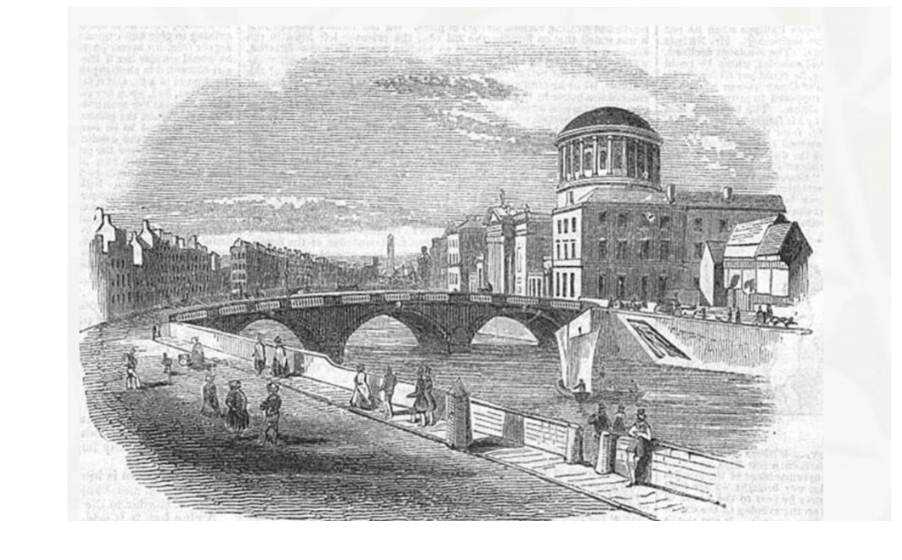
This lovely image of the Four Courts from ‘The Land We Live in: a Pictorial and Literary Sketch-Book of the British Empire’ (1847-51) was accompanied by a beautifully written homage to the unparalleled vibrancy of the Round Hall as it… Continue reading
On July 28, 1902, the Dublin Leader published the entirety of a one-act play by Edward Martyn, ‘The Place-Hunters,’ set in the Law Library of the time and satirising Irish barristers’ struggle between principle on the one hand and personal benefit… Continue reading
The ceremony of laying the foundation stone of the new Four Courts took place in May 1786 and was presided over by the Lord Lieutenant of Ireland, Charles Manners, Duke of Rutland. The below account of the ceremony from an… Continue reading
A 1780 advert in the Dublin Evening Post from Mr English, wig-seller, referencing his dressing room at the rear door of the old Four Courts in Christchurch, where Irish barristers of the period could get their wigs powdered daily. Although… Continue reading