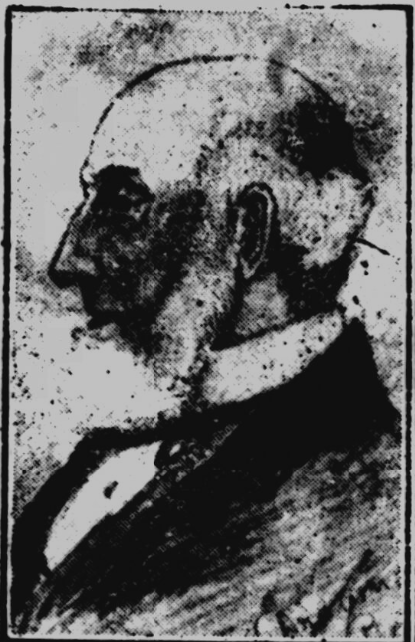

From the Dublin Evening Telegraph, 13 November 1915:
“FOUR COURTS OFFICIAL
NOTABLE PERSONAGE DEAD
Last night Mr Michael Fitzpatrick, Senior Tipstaff at the Four Courts, died at his residence, 7 Leo street. The announcement will be received with regret by all who knew him as a conspicuous figure in the Central Hall at the Courts. He was 98 years of age, held the position of Tipstaff for over sixty years, and was the oldest official connected with the Courts. Notwithstanding his great age he was able to attend to his duties up to a few weeks ago. He had a great fund of information, especially with regard to the Bar and Bench of Ireland, and hardly a name distinguished in the annals of the legal profession for more than half a century could be mentioned without drawing from him some biographical details or reminiscences of the eminent personage referred to.
His extraordinary physical vitality was seen by his capacity to face the terrors of winter weather up to the last always. He was rarely, if ever, muffled up, and generally, even with the thermometer very low, wore his coat open at the throat. His figure retained its straightness, and five years ago anyone asked to give his age would have subtracted a quarter of a century from his real great age. He was an exceptionally well-mannered old gentleman, on whose good temper and natural courtesy time had no injurious effect.”
A ceremony had been held in the Four Courts in 1905 to commemorate Mr Fitzpatrick’s golden jubilee of service to the legal profession, at which he shared some recollections of his lifetime. The Irish Independent of 14th January 1905 included some extracts from his speech:
“I remember the burning of the Arcade in College green, the burning of the Bethesda Church, and I walked across to College green to see the statue of King William lying on the ground after it had been blown down, and I saw a lady leaving the house in North Great George’s street in a sedan chair. I was at the opening of the Great Exhibition, and when her Majesty the late Queen was passing one of the stalls, the Scotchwoman in charge held out some comfits, which the Queen took in her gloved hand, and turning laughingly to the Prince Consort, said ‘here, Albert, take some.’”
Ah,’ commented Mr Fitzpatrick, ‘She was a lively lass then, and the Prince a splendid-looking man.’
The Independent further noted, regarding Mr Fitzpatrick, that
“The Yelverton case is fresh in his memory, and the scene at the close of the sensational trial he describes as most extraordinary. Not alone was the Central Hall crowded with cheering people, but outside the building there was a vast throng, and as the Hon. Mrs Yelverton left in an open carriage with four white horses, the enthusiasm was at its height. It was dark at the time, and when she reached the Shelbourne Hotel she made a speech, telling the crowd ‘that for ever she belonged in heart and soul to the people of Dublin.’”
To an inquiry as to whether he could recall the Judges and counsel in the Yelverton case, Mr Fitzpatrick replied
‘Of course I can. There was lord Chief Justice Monaghan, and as he was then Mr Edward Sullivan, a little man with a big voice, and a kind heart. Then there was Whiteside. I remember him coming down with the North-West Bar, and he was out always early in the morning, wearing a wide-awake hat. Between the morning air and the cuckoo’s spit, he never missed anything that was available.
‘I travelled with the North-West Circuit, had charge of the mess arrangements, went to the post offices for the letters and briefs, and never lost a letter or a brief in my life. I remember four Fathers of the Bar on that Circuit. When Judge Keogh came down, a special engine was sent along the line in front of the train he travelled in and once when he arrived at Enniskillen they burned his effigy.
On that Circuit, there were some great trials. One time Isaac Butt came down to defend the late Mr JGV Porter, of Belleisle, in an action taken against him by an officer whose visits to his house he did not like. Mr Porter took the officer out in a boat on the lake, gave him a thrashing and dipped him in the water. We were trying our best to keep the court in good order, but the people were so anxious to hear Butt’s speech that they hung out of the banisters of the gallery. The jury acquitted Porter for they thought that the officer deserved what he got, and as Porter left the dock and went out with Butt, it was the grandest sight I have ever seen.
Then there was the trial at Omagh of Montgomery for the murder of a bank clerk named Glass. He was tried three times, and Mr Macdonagh defended him, and I never saw anybody so vexed as he was when the prisoner after he was convicted admitted his guilt.
Mr JP Hamilton was on that Circuit, and the gentlemen of the Bar used to call him ‘Little Jimmie’. He was greatly liked. He was made Recorder of Cork, and when he was not feeling well the doctors sent him to the South of France, but he told me that if he had gone to the south of Cork he would have been much better.
There were ever so many members of that Circuit who all become Judges. There is Judge Holmes, Judge Andrews, and ever so many more. I have every reason to be grateful to the gentlemen who treated me most kindly and most genially all these years, but at eighty-six years of age I am not strong enough to travel any more.”
In concluding, the Independent remarked that
“Mr Fitzpatrick is a most wonderful veteran, and he is as clear and alert, in spite of his years, as many men not half his age. The appreciation in which he is held by the Bar is testified by the subscriptions given to the testimonial which has just been inaugurated.”


Leave a Reply